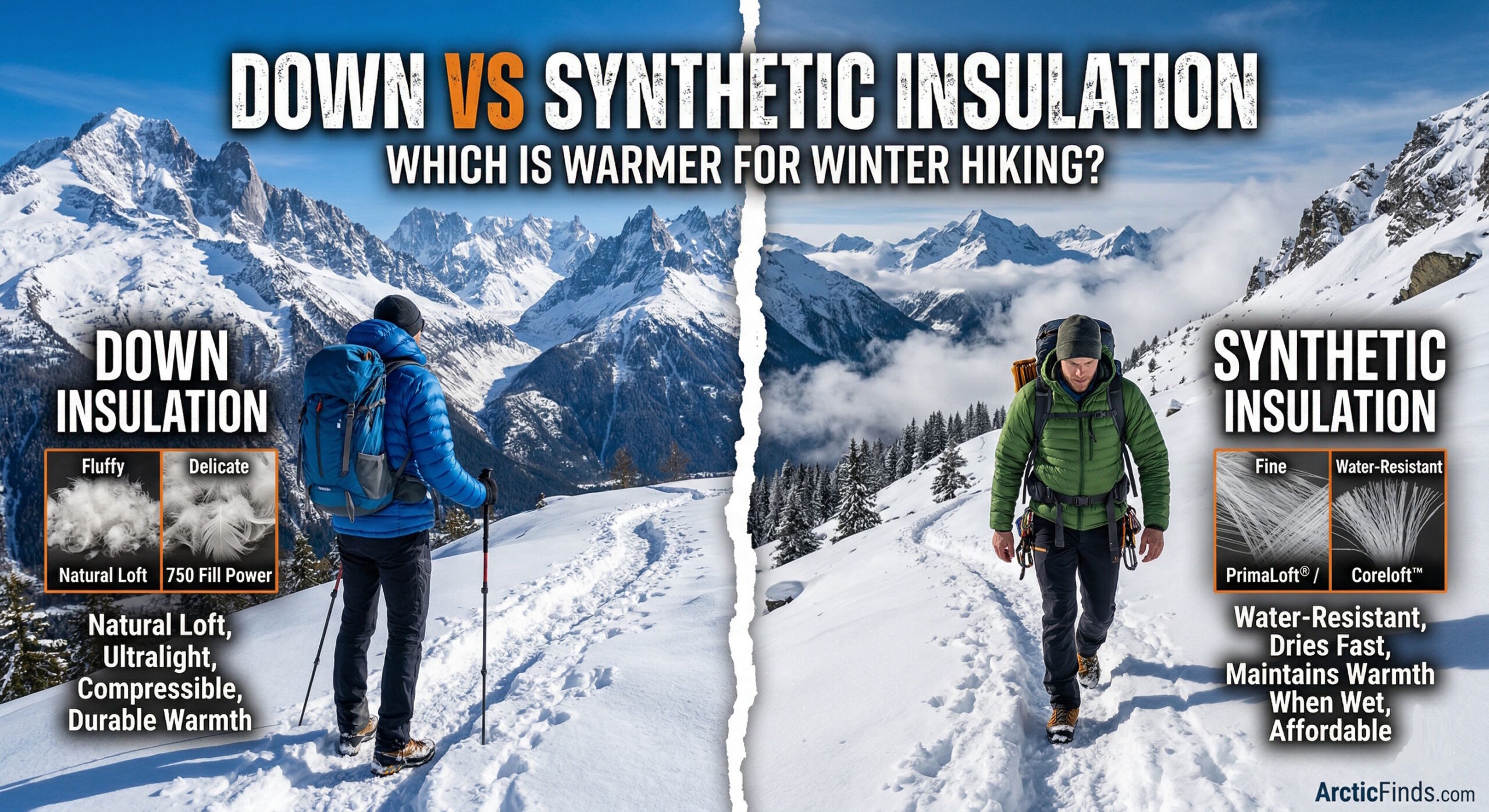
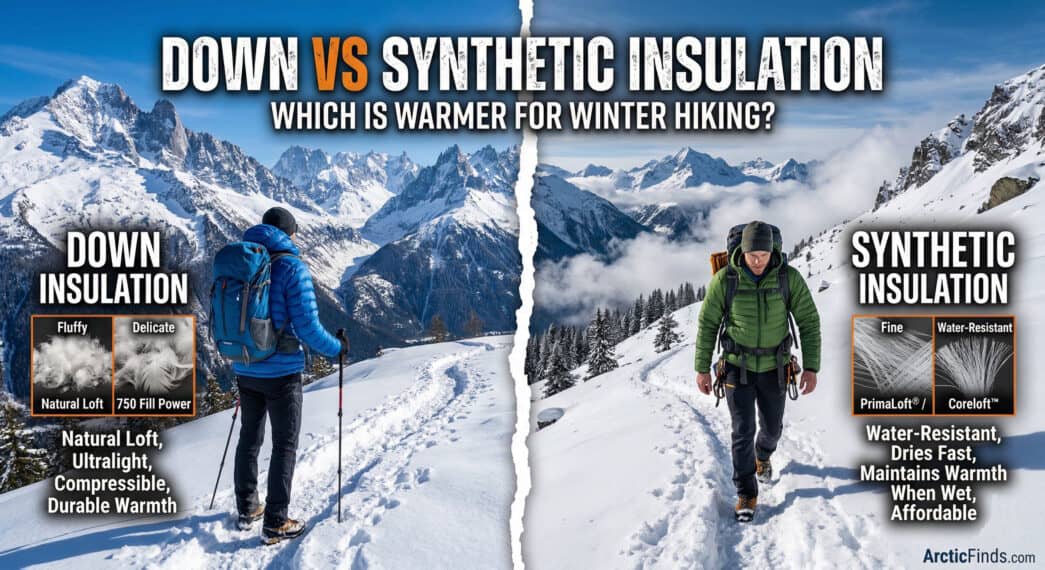
The short answer: choose down for cold, dry conditions where packability and warmth-to-weight matter most. Choose synthetic if you’ll face wet weather, sweat heavily, or need a budget-friendly option that performs even when damp.
After testing dozens of jackets across alpine climbs, winter camping, and everyday commutes, here’s everything you need to make the right call.
What’s in This Guide
- Fill Power Explained
- Pros & Cons of Each
- Head-to-Head Comparison
- Wet Conditions & Hydrophobic Down
- Which Is Best for Your Activity
- Layering System Guide
- Washing & Care
- Sustainability
- Hybrid Jackets
- Final Verdict
Fill Power Explained
Fill power measures how much space one ounce of down occupies in cubic inches. Higher fill power = more loft = more trapped air = more warmth per gram. It says nothing about total warmth — that also depends on how much down is actually in the jacket.
| Fill Power | Quality Tier | Best Use | Typical Price |
|---|---|---|---|
| 600–650 | Good | Casual / everyday | $80–$150 |
| 700–750 | Very good — the sweet spot | Hiking, camping, travel | $150–$280 |
| 800–850 | Excellent | Backpacking, mountaineering | $280–$450 |
| 900+ | Premium | Expedition, ultralight | $400+ |
Pro tip: A 700-fill jacket with 150g of down will outperform an 850-fill jacket with only 80g of down. Always check both fill power and fill weight before buying.
Pros & Cons of Each
Down Insulation
✓ Pros
• Best warmth-to-weight ratio of any insulation
• Compresses to a fraction of its size (packable)
• Extremely durable — lasts 20+ years with care
• Breathes well during moderate activity
• More comfortable against skin over long periods
✗ Cons
• Loses most insulating ability when wet
• Takes a long time to dry in the field
• More expensive than equivalent synthetic
• Ethically sourced down requires RDS certification
• Not vegan
A note on ethical sourcing: Look for the Responsible Down Standard (RDS) or Global Traceable Down Standard (Global TDS) certification on any down jacket you buy. These certify that geese were not live-plucked or force-fed. Brands like Patagonia, Arc’teryx, and Rab all use certified down.
Synthetic Insulation
✓ Pros
• Retains ~70% insulating ability when wet
• Dries much faster than down
• Significantly cheaper at equivalent warmth ratings
• Vegan and allergy-friendly
• Better choice for high-output aerobic activities
• Often more durable in very wet climates
✗ Cons
• Heavier and bulkier than down at same warmth
• Compresses less (not as packable)
• Degrades faster — typically 3–5 years of heavy use
• Less breathable during stop-start activity
• Made from petrochemicals (though recycled versions exist)
What About Active Insulation?
Active insulation is a synthetic subcategory designed for high-aerobic use — think ski touring, trail running, or fast-and-light alpine climbing. Brands like Polartec Alpha (used by Arc’teryx) and Polartec FullRange use an open-cell structure that dumps excess heat while maintaining warmth when you stop. These are not the same as standard synthetic fill. If you sweat heavily during your activity, an active insulation piece worn as a mid-layer is worth considering over either standard down or synthetic.
Quick Decision Guide
Choose Down if you:
• Prioritize warmth-to-weight
• Need maximum packability
• Stay mostly dry
• Invest in gear long-term
• Do alpine or expedition trips
Choose Synthetic if you:
• Face frequent rain or wet snow
• Sweat heavily during activity
• Are on a tighter budget
• Want vegan/animal-free gear
• Need faster drying in the field
Head-to-Head Comparison
| Factor | Down | Synthetic | Winner |
|---|---|---|---|
| Warmth (dry) | Exceptional | Very good | Down |
| Warmth (wet) | Poor (20–30% retained) | Good (60–70% retained) | Synthetic |
| Weight | Lightest | 20–40% heavier | Down |
| Packability | Excellent — stuff-sack small | Moderate — compresses less | Down |
| Price | $150–$500+ | $80–$250 | Synthetic |
| Durability | 10–20+ years | 3–7 years | Down |
| Drying speed | Slow (4–6 hrs) | Fast (1–2 hrs) | Synthetic |
| Care | Needs down-specific wash | Standard machine wash | Synthetic |
| Vegan | No | Yes | Synthetic |
Wet Conditions & Hydrophobic Down
Down’s biggest weakness is moisture. When down clusters get wet, they clump together and lose nearly all their loft — and their warmth. In genuinely wet environments like the Pacific Northwest or Scottish Highlands, this is a real problem.
The solution many brands have adopted is hydrophobic down treatment — a DWR-like coating applied to individual down clusters. This is sold under names like DownTek (Marmot, Eddie Bauer), HyperDRY (The North Face), and Q.Shield DOWN (Mountain Hardwear).
Honest Verdict on Hydrophobic Down
Hydrophobic down genuinely works — but it has limits. It resists light moisture and condensation well, and it dries noticeably faster than untreated down. However, extended immersion or prolonged heavy rain will still saturate it and reduce loft. It is not a replacement for synthetic insulation in truly wet conditions.
Bottom line: If you mostly hike in damp but not soaking conditions, hydrophobic down is worth the slight premium. If you regularly face sustained downpours or risk full submersion, synthetic remains the better choice.
Which Is Best for Your Activity
Scenario 1: Winter Backpacking (Cold & Dry)
Winner: Down
In cold, dry alpine conditions — Colorado Rockies in January, Patagonia in winter, or high-altitude camping — down is unmatched. A 700–800 fill power jacket will keep you warmer at half the weight of an equivalent synthetic.
Top Picks: Arc’teryx Cerium Hoody • Patagonia Down Sweater Hoody
Scenario 2: Skiing & Resort Days
Winner: Synthetic (or Hydrophobic Down)
Ski resorts mean variable conditions — warm chair lifts, cold runs, occasional wet snow. You’ll also sweat. A synthetic or hydrophobic down jacket handles this range better than standard down.
Top Picks: Patagonia Nano Puff • The North Face ThermoBall Eco
Scenario 3: Everyday Urban Use
Winner: Down (cold climates) / Synthetic (wet or mild climates)
For city commutes in dry cold climates, down wins on warmth, packability, and long-term value. If you live somewhere rainy like Seattle or Amsterdam, a synthetic or treated down jacket holds up better day-to-day.
Top Picks: Uniqlo Ultra Light Down • Rab Microlight Alpine
Scenario 4: High-Output Activities (Ski Touring, Trail Running)
⚠ Neither Standard Insulation — Use Active Insulation
If you’re generating heat through sustained aerobic effort, both standard down and standard synthetic will cause overheating and internal moisture buildup. Use active insulation (Polartec Alpha or Polartec FullRange) as a mid-layer instead — it dumps excess heat while moving and insulates when you stop.
Top Picks: Arc’teryx Atom LT Hoody • Rab Xenair Alpine
If you sweat heavily, reconsider down for active use. Perspiration from the inside is just as damaging to down loft as rain from the outside. Moisture vapor from your body accumulates in the insulation during aerobic activity. For anything involving sustained effort, synthetic or active insulation is the smarter pick — regardless of external weather.
Weight & Packability
Down wins this category decisively. A quality 700-fill down jacket typically weighs 280–380g and packs to the size of a softball. An equivalent synthetic jacket runs 400–550g and packs to roughly the size of a Nalgene bottle. For ultralight backpackers this gap is significant; for car campers, it barely matters.
Washing & Care
| Step | Down Jacket | Synthetic Jacket |
|---|---|---|
| Wash with | Down-specific cleaner (Nikwax Down Wash Direct or Grangers Down Wash) | Standard mild detergent or Nikwax Tech Wash |
| Machine settings | Gentle cycle, cold water, no spin | Gentle or normal cycle, cold water |
| Never use | Fabric softener, bleach, dry cleaning solvents | Fabric softener, bleach |
| Drying | Tumble dry low with 2–3 clean tennis balls for 60–90 min to break up clumps | Tumble dry low or air dry flat |
| Frequency | Once or twice per season; spot clean between washes | Every 2–3 weeks of heavy use |
| Storage | Hang or store loosely — never compress long-term | Can store compressed; less sensitive to compression |
Critical: Never dry clean a down jacket. The solvents destroy the natural oils in down clusters that keep them flexible and lofty. Use Nikwax Down Wash Direct and take your time drying — under-dried down will clump permanently and grow mildew.
Layering System Guide
| Layer | Purpose | Best Material | Example Products |
|---|---|---|---|
| Base Layer | Moisture wicking; move sweat away from skin | Merino wool or synthetic wicking — not insulation | Icebreaker 200 Oasis, Patagonia Capilene |
| Mid Layer (active) | Insulation during movement; must breathe and dump heat | Active synthetic (Polartec Alpha / FullRange) or fleece | Arc’teryx Atom LT, Rab Xenair, Patagonia R1 |
| Mid Layer (static) | Insulation at rest, at camp, in cold belay stances | Down preferred; synthetic if wet conditions likely | Patagonia Down Sweater, Rab Microlight, TNF Summit Series |
| Outer Shell | Wind and waterproof protection | Hardshell or softshell — not insulation | Arc’teryx Beta AR, OR Foray, Marmot Minimalist |
Sustainability
| Factor | Down | Synthetic |
|---|---|---|
| Raw material | Animal byproduct — ethical concerns without certification | Primarily virgin polyester (petrochemical-derived) |
| Recycled options | Limited (some brands use recycled down) | Widely available — recycled PET from plastic bottles |
| Longevity | 20+ years with care = fewer products over lifetime | 3–7 years = more frequent replacement |
| End of life | Biodegradable | Non-biodegradable; microplastic shedding during washing |
| Key certifications | RDS, Global TDS | bluesign, OEKO-TEX, recycled content labels |
From a lifecycle perspective, a well-cared-for down jacket lasting 15 years likely has a lower overall environmental footprint than three synthetic jackets replaced over the same period. The primary ethical concern with down is animal welfare, not necessarily carbon output.
Hybrid Jackets: The Best of Both?
Some manufacturers place down insulation in the chest and back (where warmth matters most and moisture is lowest) and synthetic insulation under the arms and sides (where sweating occurs). The result is warmer and lighter than pure synthetic, while more active-friendly than pure down.
Arc’teryx Cerium Hoody — 850-fill RDS-certified down in the body with Coreloft synthetic under the arms. Best-in-class warmth-to-weight for serious mountaineers.
Mammut Eigerjoch Advanced IN Hooded Jacket — Down-primary hybrid with targeted synthetic zones. Excellent for alpine touring. More affordable than Arc’teryx with no meaningful performance gap for most users.
Hybrids cost more than pure synthetic and are slightly bulkier than pure down. For casual hiking or everyday use, a single-insulation jacket is simpler and often better value.
Final Verdict
The Bottom Line
Go with Down when:
• Cold, dry environments
• Weight and packability are priorities
• You’re investing in gear for years
• Mostly stationary or low-output activity
• Alpine, expedition, or winter camping
Go with Synthetic when:
• Wet, rainy, or variable conditions
• High-output aerobic activity
• Budget is a constraint
• Vegan or animal-welfare concerns
• Casual use, resort skiing, damp climates
“The best insulation is the one that matches your specific conditions — not the one with the highest fill power rating.”