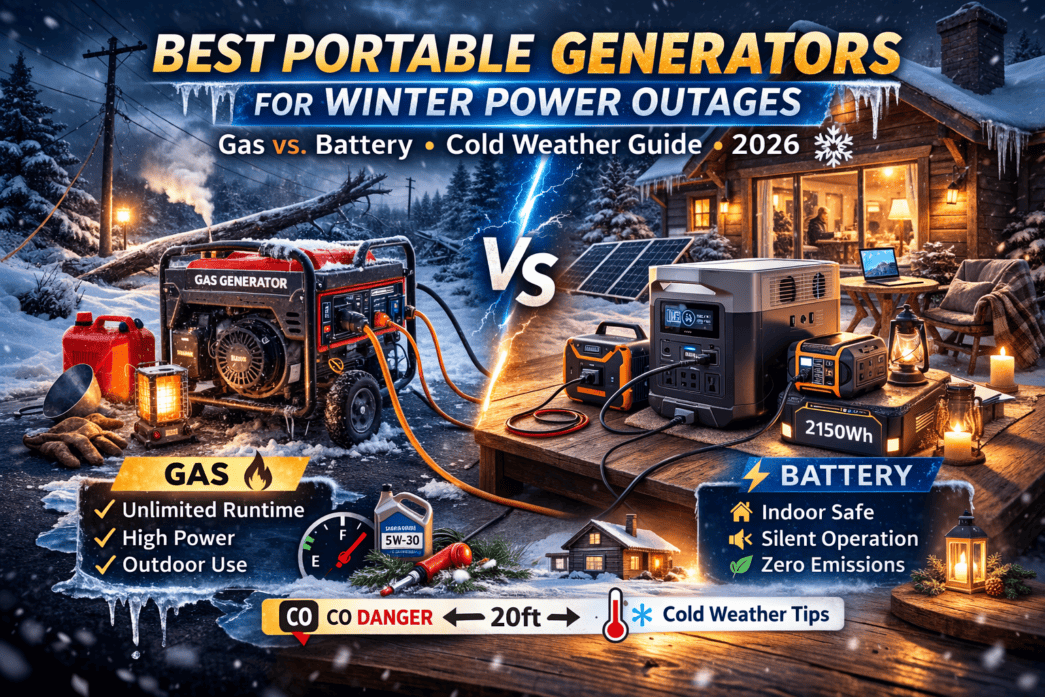
If you live somewhere that gets real winters — northern Canada, Scandinavia, the upper Midwest, or anywhere storms regularly knock out power for days at a time — a portable generator is not a luxury. It is the difference between a manageable situation and a genuinely dangerous one. The question is not whether you need one. It is which type actually performs when temperatures drop below freezing and the grid goes dark.
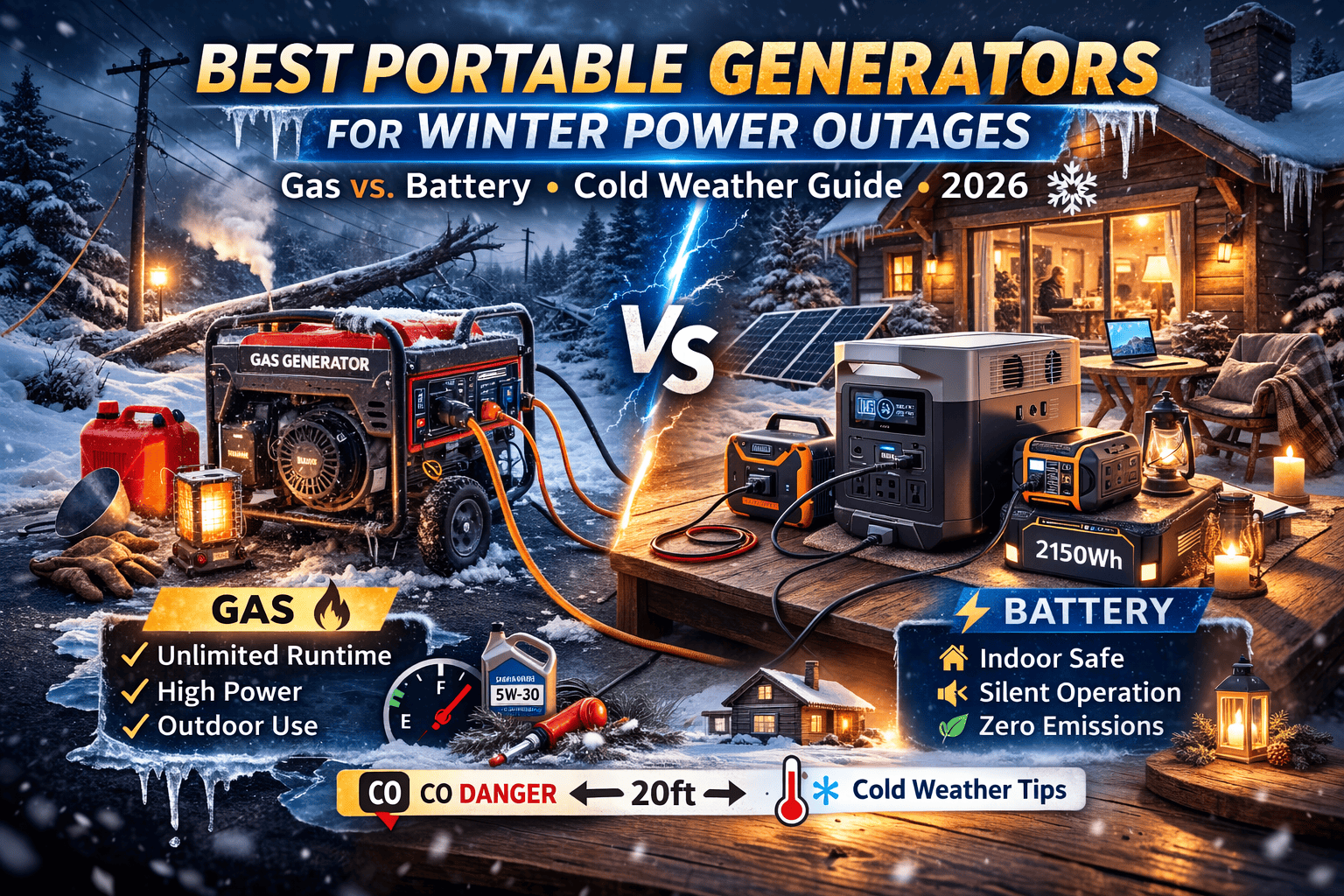
This guide covers the best portable generators for winter power outages in 2026, across two very different categories: traditional gas generators that run indefinitely as long as you have fuel, and battery power stations that are silent, emission-free, and safe to use indoors. We have reviewed six products in total and broken down the cold-weather details that most review sites skip entirely.
⚠️ Generators and battery stations sell out fast before major winter storms. Check current availability on Amazon before storm season hits — not after.
Quick Answer: Best Pick in Each Category
| Need | Best Pick |
|---|---|
| 🥇 Best quiet gas generator for winter | Honda EU2200i |
| 💪 Best generator for whole-home winter backup | DuroMax XP10000E |
| ⚡ Best budget gas inverter | maXpeedingrods MXR2400GT |
| 🏆 Best indoor battery station | EF EcoFlow DELTA 2 Max |
| 🌲 Best battery for off-grid cabin | Lipower 2150Wh |
| 💼 Best compact battery backup | Generac GB1000 |
Gas Generator vs. Battery Power Station: Which Do You Actually Need?
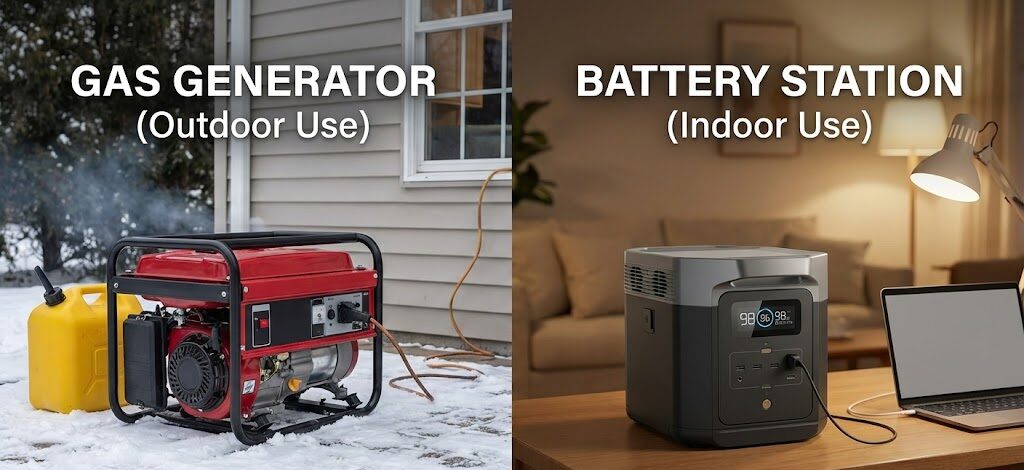
This is the most important decision in the guide — and it is one most buyers get wrong. People often buy a battery station assuming it can replace a gas generator, or buy a gas generator without thinking through the CO risk. Neither mistake is cheap.
Gas generators and battery stations solve genuinely different problems. Here is the honest breakdown:
| Factor | ⛽ Gas Generator | 🔋 Battery Power Station |
|---|---|---|
| Runtime | Unlimited with fuel refills | Fixed — depends on battery capacity |
| Location | Outdoors only — produces CO | Indoor-safe — zero emissions |
| Cold Weather | Needs cold-start prep; fuel may thicken | Capacity drops ~20–30% below 32°F (0°C) |
| Noise | Moderate to loud | Silent |
| Power Range | 1,000W to 10,000W+ | 500W to 3,600W typical |
| Cost to Run | Ongoing fuel cost | Free with solar; grid cost otherwise |
| Best For | Extended outages, heavy tools, heating | Electronics, short outages, indoor use |
🚨 CO Safety — Non-Negotiable: Never run a gas generator indoors, in a garage, or near windows or doors — even with the garage door fully open. Carbon monoxide is odorless, colorless, and lethal within minutes at high concentrations. Keep the unit at least 20 feet from the home with the exhaust pointing away from any openings. Install battery-powered CO detectors on every floor. Battery power stations produce zero emissions and are completely safe to use indoors.
How to Choose the Right Generator for Cold-Weather Conditions
Where will you use it?
If you need power indoors, in a garage, or in any enclosed space — battery station only. There is no safe workaround for CO with a gas generator in an enclosed space. If you are outdoors, on a ventilated jobsite, or at a remote property, a gas generator is fine provided it is positioned correctly.
How long is the outage likely to be?
For outages under 8 hours, a battery station is more practical — charge it beforehand and you are ready. For multi-day blackouts typical of serious winter storms, a gas generator is the more dependable choice: refuel it and it keeps running indefinitely.
What are you actually powering?
Heavy loads — furnace fans, water pumps, space heaters, power tools — need the high wattage ceiling of a gas generator. Light loads — phones, laptops, a router, LED lights, or a CPAP machine — are easily and more safely handled by a battery station.
The wattage reality check
Before buying anything, add up the wattage of everything you plan to run simultaneously. Motors draw significantly more power at startup than at running speed — this catches a lot of buyers off guard.
| Appliance / Tool | Running Watts | Starting Watts |
|---|---|---|
| Refrigerator | 150–400W | 1,000–1,200W |
| Space Heater (1,500W) | 1,500W | 1,500W |
| Furnace Fan | 400–800W | 1,400W |
| CPAP Machine | 30–60W | 60W |
| Laptop | 50–100W | 100W |
| LED Lighting (10 bulbs) | ~100W | 100W |
| Circular Saw | 1,200–1,800W | 2,400W+ |
| Well Pump (1/2 HP) | 1,000W | 2,000W |
Two things every ArcticFinds reader should know before buying:
- A 2,200W gas inverter like the Honda EU2200i can run a furnace fan and a fridge during a 3-day outage — but you will need a fuel rotation plan. At moderate load, budget 1–2 gallons per day. Four full cans gets most people through a serious storm.
- A 2,048Wh battery station will not run a 1,500W space heater overnight. At that draw, you get roughly 1.2 usable hours before it is dead. Battery stations are the right tool for laptops, lights, and medical devices — not space heaters. That is math, not marketing.
Cold-Weather Challenges: What Actually Happens Below Freezing
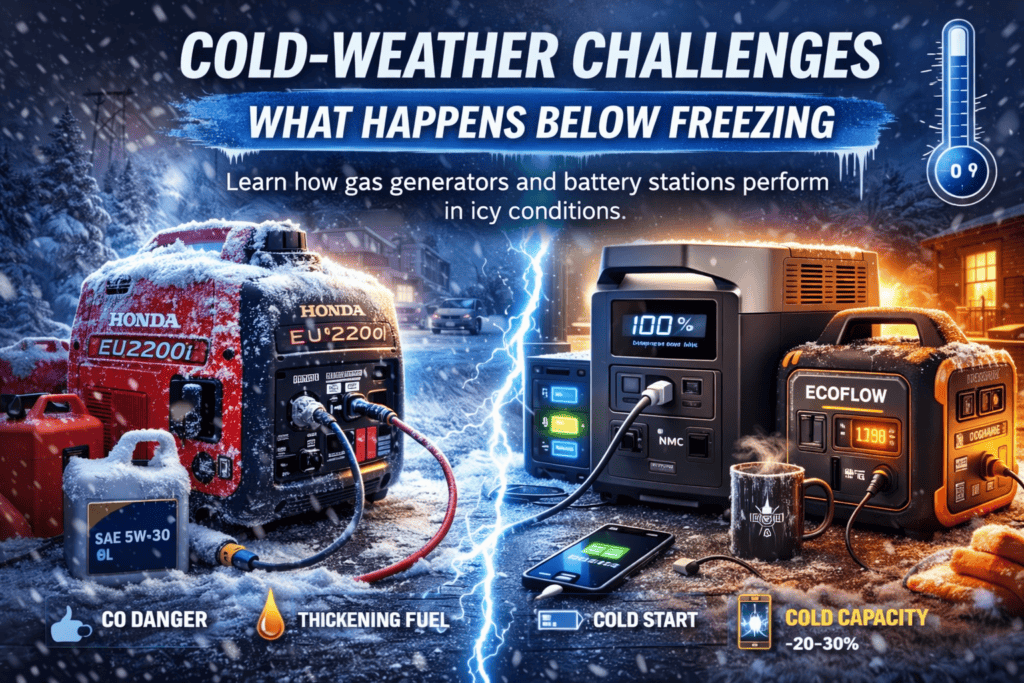
❄️ Gas generators in cold weather
Standard engine oil (SAE 30) thickens dramatically in sub-freezing conditions, making cold starts harder on the engine and sometimes impossible. Switch to SAE 5W-30 before winter. Fuel also degrades quickly in storage and can gum up carburetors — always use fresh gasoline with a stabilizer added. And do not overlook the physical: snow and ice can block exhaust vents, which is both a CO hazard and a performance issue. Clear the unit before every single use.
🔋 Battery power stations in cold weather
All lithium batteries lose usable capacity in the cold — expect a 20–30% reduction below 32°F (0°C). Chemistry matters more than brand here:
- LiFePO4 chemistry (EcoFlow DELTA 2 Max, Lipower) handles cold significantly better and has a much longer cycle lifespan — 3,000+ charge cycles versus roughly 500–800 for NMC.
- NMC chemistry (Generac GB1000) loses more capacity in cold, degrades faster with repeated cold-weather use, and can be permanently damaged if discharged heavily while frozen.
Always warm a frozen battery station to at least 40°F (4°C) before charging. This applies to every unit in this lineup — charging a frozen lithium battery causes permanent internal damage regardless of chemistry.
💡 Propane vs. Gasoline in Extreme Cold: Propane stores indefinitely and can be easier to start in moderate cold. But propane tank pressure drops sharply below 0°F (-18°C), which can reduce generator output or stop it from starting. In genuinely extreme cold, fresh gasoline with stabilizer is typically more reliable. If your generator is dual-fuel, test both options before storm season — not during it.
Safety essentials for winter generator use
- Position gas generators at least 20 feet from any door, window, or vent, with exhaust facing away from the home
- Use a weatherproof generator canopy in snow and rain — but keep all ventilation openings fully open
- Run the generator for 20–30 minutes every 3–4 weeks through the season, even when you do not need it — this keeps the carburetor clear and confirms it will start when a storm arrives at 2am
- Install battery-powered CO detectors on every floor of the home
- Keep a fire extinguisher accessible near your setup
How to Connect a Generator to Your Home Safely
If you are buying a generator for whole-home winter backup, you need to think beyond running extension cords. There are three main options, and one of them is illegal.
Extension cord method: Fine for running a fridge, a lamp, and a device charger. Not practical for a furnace or any permanently wired appliance. Use 12-gauge or thicker outdoor-rated cords only.
Interlock kit: A code-compliant bracket (~$50–$150) that mounts to your existing breaker panel and prevents the main breaker and generator input from being on simultaneously. You plug the generator into a dedicated exterior inlet and manually flip circuits. Requires a licensed electrician to install in most jurisdictions — but this is the best balance of cost, safety, and convenience for most homeowners.
Transfer switch: A dedicated sub-panel with 6–10 pre-selected circuits that you can switch from grid to generator power with a single lever. Hardware costs $200–$500 plus electrician labor. Completely eliminates any risk of back-feeding the grid. The gold standard if you plan to use a generator every winter.
⚠️ Never use a male-to-male plug (“suicide cord”) to back-feed power through an outlet. This bypasses every safety protection in your home’s wiring, is illegal in most countries, and can kill utility workers restoring power to your neighborhood. If you want to power your home through the panel, use an interlock kit or transfer switch installed by a licensed electrician. No exceptions.
Best Portable Generators for Winter — Full Reviews
⛽ Gas Generators
🥇 1. Honda EU2200i — Best Quiet Gas Generator for Winter Storms

| Spec | Detail |
|---|---|
| Wattage | 2,200W surge / 1,800W running |
| Fuel | Gasoline |
| Run Time | 4–9.6 hours per tank |
| Noise | 48–57 dB |
| Weight | ~47 lbs |
The Honda EU2200i is the generator that serious winter preppers come back to year after year, and the reason is straightforward: it works, every time, without drama. It uses inverter technology, which means the power output is clean and stable enough for sensitive electronics — laptops, medical devices, TVs — not just raw appliances. At 48 dB at quarter load, it is quieter than a normal conversation, which matters considerably when you are running it through the night near a residential neighborhood.
The standout winter safety feature is Honda’s CO-Minder system, which automatically shuts the generator off if carbon monoxide levels near the unit climb into dangerous territory. It is not a substitute for proper placement and CO detectors indoors — but it is a real safety layer that no other gas generator in this lineup provides.
Real-world cold-weather use: The EU2200i can run a furnace fan (~600W) and a refrigerator (~200W) simultaneously with capacity to spare. For a three-day outage, budget around 1–2 gallons of fuel per day at moderate load and store treated fuel in approved cans. Switch to SAE 5W-30 oil before your first winter run — it makes a noticeable difference on cold starts.
- ✅ Pros: Industry-leading reliability; CO-Minder auto-shutoff; very quiet for a gas generator; clean inverter output safe for sensitive electronics; compact at 47 lbs
- ❌ Cons: Premium price; 2,200W ceiling rules out whole-home coverage; recoil start only — no electric start option, which stiffens noticeably in severe cold
Check latest price on Amazon →
💪 2. DuroMax XP10000E — Best Generator for Whole-Home Winter Backup

| Spec | Detail |
|---|---|
| Wattage | 10,000W surge / 8,000W running |
| Fuel | Gasoline |
| Run Time | ~10 hours at 50% load |
| Start | Electric start + recoil backup |
| Weight | ~300 lbs with wheel kit |
For ArcticFinds readers who need to run a furnace, well pump, refrigerator, and lights simultaneously during a multi-day winter storm, the DuroMax XP10000E is the right tool. At 10,000 watts of surge capacity, it has the headroom to power most homes without compromise. The electric start is a genuine cold-weather advantage — pull-starting a large engine in sub-freezing temperatures with stiff cords is miserable, and this unit’s electric start takes that problem off the table. The recoil backup is there if the starter battery drains in extreme cold.
This is not a quiet or subtle machine. It is loud, heavy, and consumes fuel quickly at high loads. It needs significant outdoor space well away from the home. But if your priority is maximum capacity for an extended whole-home outage and you have the space to run it safely, nothing else in this lineup comes close.
If you are running this unit to power your home through the panel, pair it with an interlock kit or transfer switch installed by a licensed electrician — see the hookup section above.
- ✅ Pros: 10,000W handles nearly any household load; electric start for cold-weather reliability; multiple 120V and 240V outlets; wheel kit included; pairs well with a transfer switch
- ❌ Cons: Very loud; large and heavy (~300 lbs); high fuel consumption at load; needs ample outdoor space; not suited for suburban use without significant distance from neighbours
Check latest price on Amazon →
⚡ 3. maXpeedingrods MXR2400GT — Best Budget Gas Inverter for Winter

| Spec | Detail |
|---|---|
| Type | Gas inverter generator |
| Fuel | Gasoline |
| Run Time | ~8 hours at 50% load |
| Wattage | Verify exact figures on the Amazon listing before publishing |
The maXpeedingrods MXR2400GT is the value alternative to the Honda EU2200i for buyers who want inverter technology — clean, electronics-safe power output — without the Honda price tag. It is quieter than open-frame generators and produces the stable power signal that sensitive devices require.
This is a newer product with a shorter track record than Honda or DuroMax. Before relying on it for serious winter use, check current customer reviews on Amazon with specific attention to cold-weather start performance and reliability over multiple seasons. For occasional seasonal backup and outdoor project use, it represents strong value at its price point.
Note for readers: Verify the exact surge and running wattage from the Amazon listing before purchasing — specs for newer models can vary between third-party sources and the actual product page.
- ✅ Pros: Clean inverter power output safe for electronics; quieter than open-frame generators; good wattage headroom for the price; budget-friendly alternative to Honda
- ❌ Cons: Less proven long-term reliability than Honda; fewer reviews; cold-weather start performance not as well documented — read current buyer feedback before purchasing
Check latest price on Amazon →
🔋 Battery Power Stations
Battery chemistry note for cold-weather use: The EcoFlow and Lipower units below use LiFePO4 chemistry — more stable in cold, longer lifespan (3,000+ cycles). The Generac GB1000 uses NMC chemistry — less cold-tolerant and with a shorter cycle life. This is the most important technical difference across the three battery stations and is worth understanding before you buy.
🏆 4. EF EcoFlow DELTA 2 Max — Best Indoor Battery Station for Winter Power Outages

| Spec | Detail |
|---|---|
| AC Output | 2,400W |
| Capacity | 2,048Wh |
| Battery Chemistry | LiFePO4 |
| Wall Recharge Time | ~1–2 hours depending on input settings |
| Cycle Life | 3,000+ charge cycles |
| Noise | Silent |
For ArcticFinds readers who need power indoors during a winter outage — without the CO risk, the noise, or the need to go outside in the cold to refuel — the EF EcoFlow DELTA 2 Max is the most capable option in this category. Its LiFePO4 battery chemistry handles cold weather better than NMC alternatives, and the 2,048Wh capacity comfortably runs a refrigerator, lights, a router, and a laptop for 6–8 hours on a single charge.
The recharge speed is the feature that earns it the top spot: the DELTA 2 Max can go from empty to full in approximately 1–2 hours via a wall outlet, depending on your input settings. If utility power flickers back on during a storm, you can top it up fast and be ready for the next outage. It also supports solar input and can be expanded with additional EcoFlow battery packs for longer runtime.
Real-world winter scenario: Running a CPAP all night (~60Wh), keeping a router and laptop running through the day (~200Wh), and cycling a fridge for 12 hours (~200Wh) uses roughly 460Wh total — leaving well over half the battery for additional loads or a second day. Just do not plan to run a 1,500W space heater on it. At that draw, you get about 1.2 hours. That is not a winter heating plan.
- ✅ Pros: LiFePO4 chemistry handles cold better than NMC; 2,400W output covers most appliances; fast recharge (1–2 hours); expandable capacity; completely silent; 100% indoor-safe; 3,000+ cycle lifespan
- ❌ Cons: Premium price ($1,000–$1,500 range); limited by battery capacity — cannot run indefinitely like a gas generator; capacity still drops in severe cold (store above 32°F / 0°C when possible)
Check latest price on Amazon →
🌲 5. Lipower 2150Wh — Best Battery Power Station for Off-Grid Cabin Winter Use
| Spec | Detail |
|---|---|
| AC Output | 2,400W |
| Capacity | 2,150Wh |
| Battery Chemistry | LiFePO4 |
| Recharge | Wall, solar, car |
| Noise | Silent |
For off-grid cabins, remote winter properties, and locations where running a gas generator is not practical or permitted, the Lipower 2150Wh is the pick. It edges out the EcoFlow DELTA 2 Max on raw capacity (2,150Wh versus 2,048Wh) and shares the same durable LiFePO4 chemistry, meaning it handles cold weather well and should last thousands of charge cycles with proper care.
The solar integration is genuinely useful for off-grid setups — connect compatible panels during the day and you can maintain usable charge even in winter conditions when grid access is not available. Like all battery stations, bring it indoors overnight if temperatures are dropping severely, and never charge it from a frozen state.
Lipower is a newer brand with fewer long-term reviews than EcoFlow or Jackery. Check current ratings on Amazon before purchasing — the specs and price point are strong, but buyers who prioritise established brand support should factor that in.
- ✅ Pros: Slightly larger capacity than the EcoFlow DELTA 2 Max; LiFePO4 durability and cold-weather resilience; solar-compatible for off-grid recharging; silent; completely indoor-safe
- ❌ Cons: Less brand recognition than EcoFlow; fewer long-term reviews — verify current rating before purchasing; cold-weather charging specifications should be confirmed in the live product listing
Check latest price on Amazon →
💼 6. Generac GB1000 — Best Compact Battery Backup for Light Winter Use

| Spec | Detail |
|---|---|
| AC Output | 1,000W |
| Capacity | 1,086Wh |
| Battery Chemistry | NMC (Lithium-ion) |
| Recharge | Wall + wireless charging pad included |
| Noise | Silent |
The Generac GB1000 is the most compact and affordable battery station in this lineup, from one of the most recognisable names in backup power. It is designed for light use during shorter outages — keeping your phone charged, a laptop running, the router on, and a few LED lights going. For that specific use case, it delivers reliably and carries the trust that comes with the Generac name.
The standout feature that no other unit in this lineup offers is a built-in wireless charging pad. Small detail, genuinely appreciated at 1am during a blackout when you do not want to dig around for a cable.
⚠️ Important cold-weather limitation: The GB1000 uses NMC battery chemistry, which loses more capacity in cold than LiFePO4 and degrades faster with repeated cold-weather use. For ArcticFinds readers buying specifically for winter outage protection in cold climates, the EcoFlow DELTA 2 Max is the stronger long-term investment. If you are in a milder climate, need only light backup power, or want a compact unit for occasional use, the GB1000 is a reasonable choice — just warm it up before use and before charging if it has been stored in freezing conditions.
- ✅ Pros: Trusted Generac brand; compact and lightweight; unique built-in wireless charging pad; silent; completely indoor-safe; good value for light loads
- ❌ Cons: NMC chemistry underperforms in cold compared to LiFePO4 — meaningful limitation for a winter-focused purchase; 1,000W AC output will not run heaters or power tools; smallest capacity in the battery station category
Check latest price on Amazon →
Quick Comparison: All 6 Products
| Model | Type | Wattage / Capacity | Fuel / Source | Run Time | Cold Weather Note | Best For |
|---|---|---|---|---|---|---|
| Honda EU2200i | ⛽ Gas | 2,200W | Gasoline | 4–9.6 hrs | Cold start OK; use SAE 5W-30; stabilize fuel | Light/medium home backup |
| DuroMax XP10000E | ⛽ Gas | 10,000W | Gasoline | ~10 hrs | Electric start helps; low-viscosity oil required | Whole-home extended outage |
| maXpeedingrods MXR2400GT | ⛽ Gas | Verify on Amazon | Gasoline | ~8 hrs | Inverter tech; stabilize fuel before storage | Mid-duty outdoor use |
| EcoFlow DELTA 2 Max | 🔋 Battery | 2,400W / 2,048Wh | LiFePO4 + Wall/Solar | Load-dependent | LiFePO4 handles cold well; store above 32°F | Indoor backup, electronics |
| Lipower 2150Wh | 🔋 Battery | 2,400W / 2,150Wh | LiFePO4 + Wall/Solar | Load-dependent | LiFePO4; slight capacity drop below 32°F | Off-grid cabin, remote use |
| Generac GB1000 | 🔋 Battery | 1,000W / 1,086Wh | NMC + Wall | Load-dependent | ⚠️ NMC degrades faster in cold; warm before use | Light loads, short outages |
Winter Maintenance Tips
⛽ Gas generator maintenance
- Oil: Switch to SAE 5W-30 before winter. Standard SAE 30 thickens significantly in sub-freezing conditions and makes cold starts noticeably harder on the engine.
- Fuel: Add a stabiliser (such as STA-BIL) to gasoline before the season or any storage period over 30 days. Untreated fuel degrades and gums up carburettors — the leading cause of generator failure after storage.
- Exercise it: Run the generator for 20–30 minutes every 3–4 weeks through the winter, even when you do not need it. This keeps the carburettor clear, circulates oil, and tells you it will actually start when a storm arrives in the middle of the night.
- Filter and spark plug: Clean or replace the air filter before winter. Check the spark plug — replace if fouled or corroded.
- Storage: Keep the unit covered and dry. A purpose-built generator cover is inexpensive insurance against corrosion.
🔋 Battery power station maintenance
- Temperature: Keep units above 32°F (0°C) during storage whenever possible. Bringing them indoors overnight when temperatures drop below freezing significantly extends battery lifespan.
- Charge level: Store at 40–80% charge — not fully empty, not fully charged. Long-term storage at either extreme shortens lithium cell life.
- Charging safety: Never charge a battery station that has been sitting in sub-zero temperatures. Let it warm to at least 40°F (4°C) first. Charging a frozen lithium battery causes permanent internal damage.
- Long-term storage: If storing for more than a couple of months, top up to around 50% and recharge every 3–4 months to prevent deep discharge.
Frequently Asked Questions
Can you run a portable generator in snow or during a winter storm?
Yes, but you must protect it from direct snow and ice accumulation. A purpose-built generator canopy or weatherproof tent works well, provided all ventilation openings stay fully open. Never run a generator in a garage, shed, or any enclosed space — even with the door cracked. Clear snow from exhaust vents before every use.
How far should a generator be from your house?
At least 20 feet from any door, window, or vent, with the exhaust directed away from the home. CO accumulates faster than most people expect and penetrates buildings through very small gaps. Distance and exhaust direction both matter. Install CO detectors inside regardless.
What is the best generator for running a furnace in winter?
Most forced-air furnace fans require 400–800W running and up to 1,400W to start. A 2,000W+ inverter generator like the Honda EU2200i handles most furnace fans on its own. To run a furnace plus a refrigerator and lights simultaneously, you want at least 3,500–5,000W. For a fully loaded home across multiple days, the DuroMax XP10000E is the right answer.
Is propane or gasoline better for a winter storm generator?
Both have genuine tradeoffs. Propane stores indefinitely without degrading and is easier to start in moderate cold. But propane tank pressure drops sharply below 0°F (-18°C), which can reduce output or prevent starting in genuine Arctic conditions. Fresh gasoline with stabiliser is typically more reliable in severe cold. If your generator is dual-fuel, test both before storm season.
Will cold weather damage a battery power station?
Using one in cold will not damage it, but you will lose 20–30% usable capacity below freezing. The real risk is charging a unit that has been frozen — this causes permanent cell damage in all lithium chemistries. Warm it to at least 40°F before plugging in. LiFePO4 units (EcoFlow, Lipower) tolerate cold significantly better than NMC units (Generac GB1000) for both performance and long-term lifespan.
How much battery capacity do you need for a winter power outage?
Add up the wattage of what you plan to run and multiply by hours. Example: router (10W) + 4 LED lights (40W) + laptop (65W) = 115W. A 1,000Wh station runs that load for roughly 7–8 hours. A refrigerator at around 150W running gives you 5–6 hours from a 1,000Wh unit. Size up for multiple devices or overnight coverage — and remember that a 1,500W space heater is not a realistic load for any battery station in this lineup.
Final Recommendation: Best Portable Generator for Winter Conditions
The right choice comes down to two core questions: where you need the power and how long you need it.
Choose a gas generator for outdoor use, heavy loads, and multi-day outages where refuelling is practical. The DuroMax XP10000E is the whole-home workhorse. The Honda EU2200i is the quieter, more refined pick for lighter needs. The maXpeedingrods MXR2400GT offers inverter technology at a lower price point for budget-conscious buyers.
Choose a battery power station for indoor-safe, silent backup of electronics, medical devices, and essential appliances during short-to-medium outages. The EF EcoFlow DELTA 2 Max is the top pick — best cold-weather chemistry, fastest recharge, expandable. The Lipower 2150Wh edges it on raw capacity for off-grid cabin setups. The Generac GB1000 is a solid compact option for light loads above freezing — just bear in mind its NMC chemistry makes it the weakest cold-weather performer of the three battery stations.
For serious winter preparedness in genuinely cold climates, the ideal setup is both types together — a gas generator for heavy outdoor loads and a battery station for indoor electronics and medical devices. It is how well-prepared households handle extended Arctic-level storms. Whatever you choose, check current availability on Amazon now. These units sell out before major winter weather events arrive.
⚠️ Check availability before storm season. Portable generators and battery stations sell out quickly in the days before a major winter storm. Don’t let a forecast be your reminder to act.