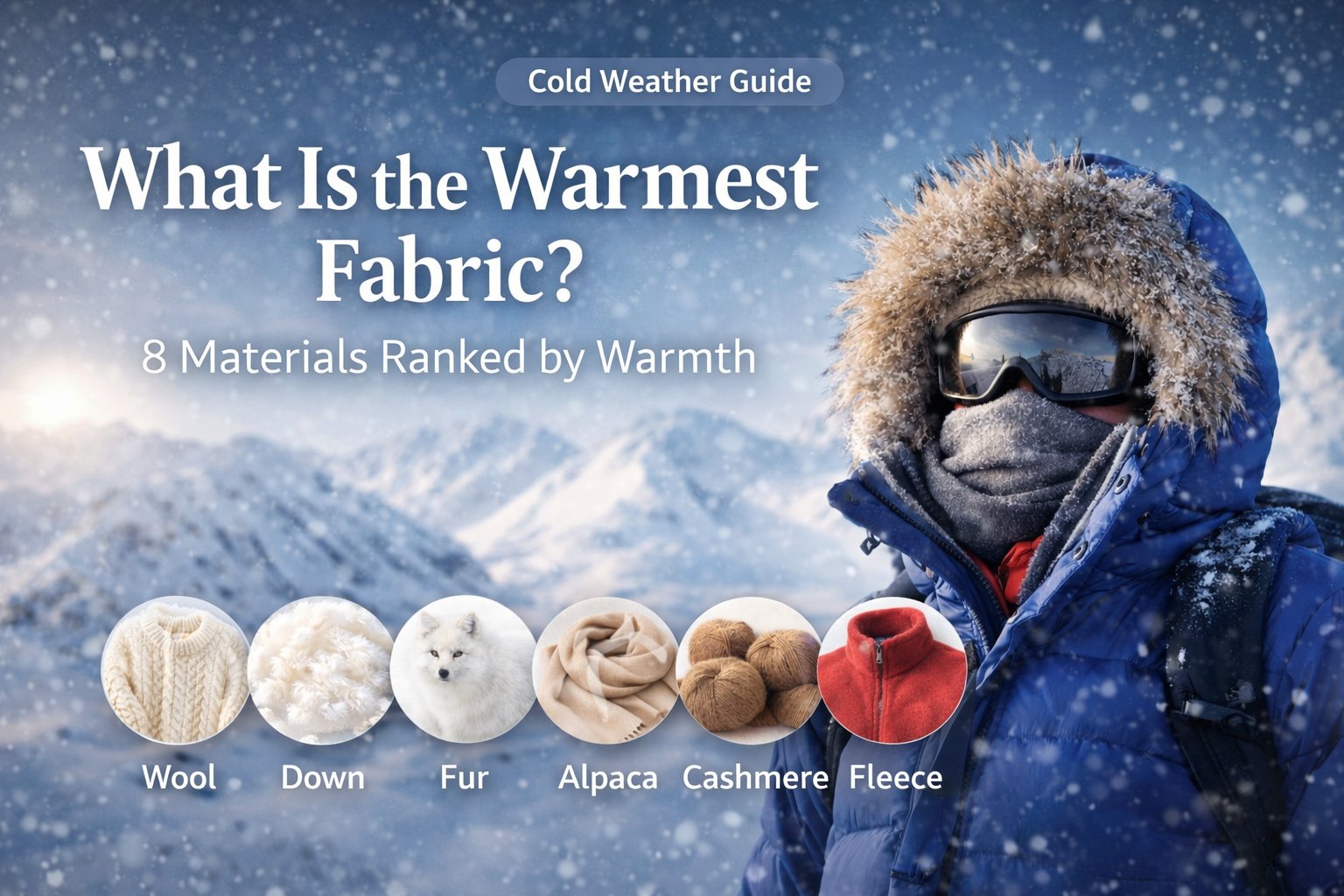
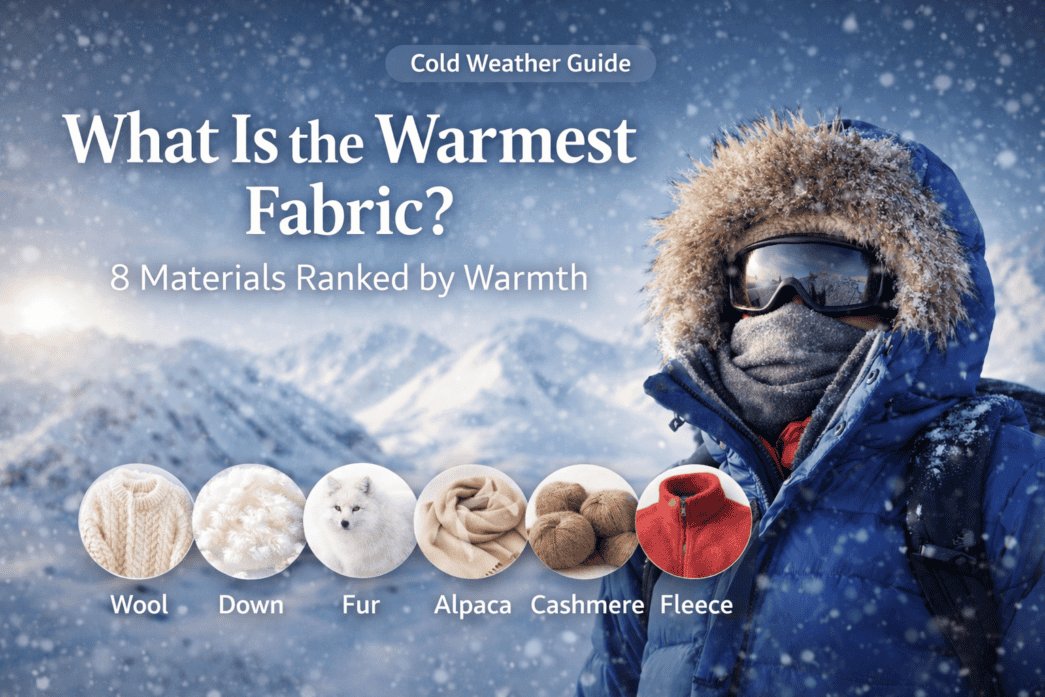
The warmest fabric for cold weather isn’t the thickest one — it’s the one that traps the most still air next to your body. Whether you’re searching for the warmest material for a winter coat, the best base layer fabric, or just trying to understand why some jumpers actually keep you warm while others don’t, this guide gives you the full picture. We’ve ranked the eight warmest fabrics and materials for cold weather from best to good, explained exactly why each one works, and included a direct comparison table so you can choose the right one for your situation.
How warmth works: trapped air and CLO values
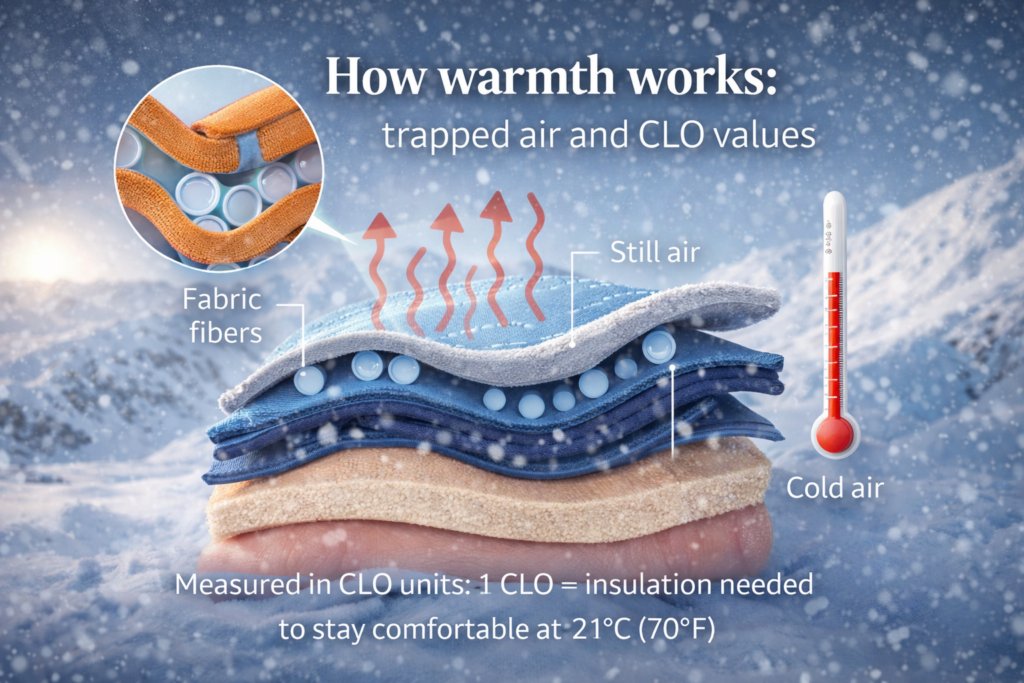
All fabric warmth comes down to one principle: trapped air. Air is an excellent insulator — but only when it can’t move. The tiny fibres in any warm material create millions of microscopic pockets that hold still air close to your skin, preventing your body heat from radiating away into the cold. The more loft (or fluffiness) a fabric has, the more air it traps, and the warmer it will be. This is why the warmest fabrics for winter are invariably soft, fluffy, or densely structured.
A secondary factor is moisture management. When you sweat, wet fibres lose their ability to trap air and conduct heat away from your body up to 25 times faster than dry fibres. This is why a damp wool jumper still keeps you reasonably warm while a damp cotton one will leave you genuinely cold — and it’s the core reason fabric choice matters so much in real-world cold weather.
Key facts at a glance:
- 25× faster heat loss through wet vs dry fabric
- CLO — the standard unit of thermal resistance used by textile scientists
- 8 warmest fabric types ranked in this guide
Textile scientists measure the warmth of any material using CLO values — one CLO equals the insulation required to keep a resting adult comfortable at 21°C (70°F). High-fill-power down insulation can reach CLO values of 3–4 per inch of loft, while a standard cotton shirt sits well below 1. The American Society for Testing and Materials standard ASTM F1868 is the recognised test method for measuring the thermal resistance and moisture vapour transmission of clothing. We reference these relative values throughout the rankings below.
Sources: Thermal insulation benchmarks — ASTM F1868 Standard · Moisture conductivity data — The Woolmark Company
The 8 warmest fabrics and materials for cold weather, ranked
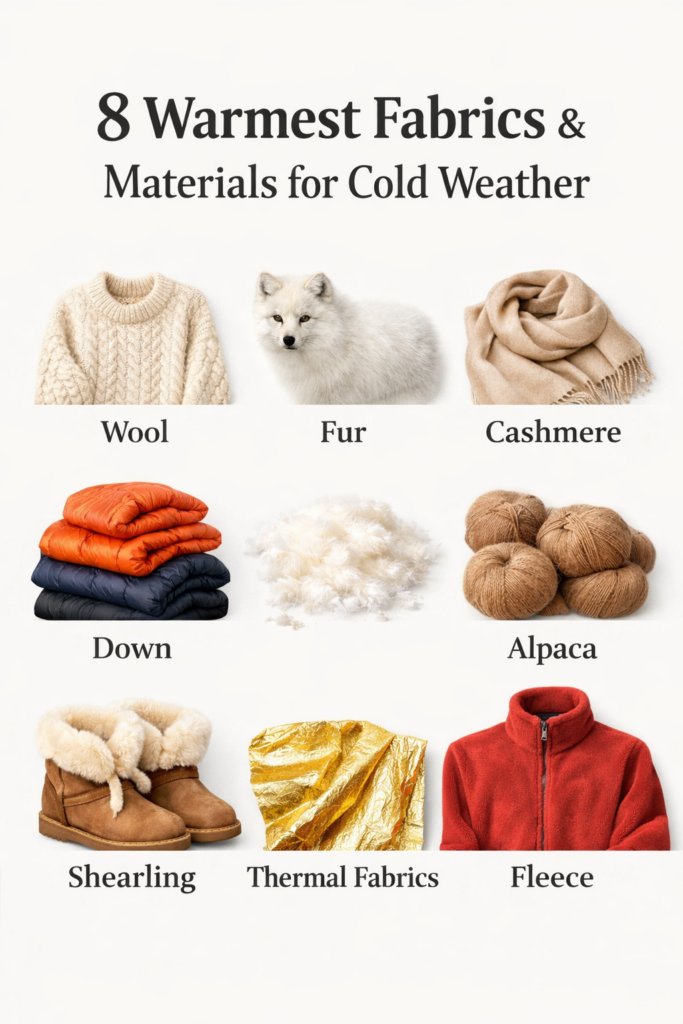
The warmest materials below are ordered by real-world warmth performance, accounting for both laboratory CLO values and moisture behaviour. The top-ranked warmest fabric in a dry lab isn’t always the smartest choice for your specific cold-weather situation — which is why each entry includes a “Best for” recommendation.
1. Down (goose & duck fill)
Highest warmth-to-weight ratio of any insulation material
Warmth rating: ●●●●● (5/5) | Best for: Extreme cold & alpine conditions
Down is the soft underplumage beneath the outer feathers of geese and ducks. Its three-dimensional cluster structure creates an extraordinary amount of loft relative to its weight — giving it the highest warmth-to-weight ratio of any natural or synthetic insulation material currently available. A 900-fill-power goose down jacket can keep you warm at −30°C while weighing under 400 grams.
The critical number to understand is fill power — the volume in cubic inches that one ounce of down can occupy. Ratings run from 500 (budget) to 950+ (expedition-grade). Higher fill power means more air trapped per gram: lighter and warmer simultaneously. Goose down generally outperforms duck down at equivalent fill powers.
Down’s significant weakness is moisture. When wet, the clusters collapse and lose almost all insulating ability. In wet climates, look for hydrophobic down, treated with a DWR-style coating that retains around 80% of its loft when damp — an important specification for anyone buying a winter jacket in the UK, Scandinavia, or the Pacific Northwest.
Pros: Exceptional warmth-to-weight ratio · Compresses into a tiny stuff sack · Lasts 20+ years with proper care · Natural, breathable feel
Cons: Loses warmth when wet (unless hydrophobic) · Premium grades are expensive · Animal welfare concerns for some · Requires careful washing
2. Wool (merino & traditional) — warmest natural all-rounder
Nature’s most versatile cold-weather fabric material
Warmth rating: ●●●●○ (4/5) | Best for: Everyday wear & base layers
Wool is the most versatile warm material for cold weather in everyday use. It’s warm, moisture-resistant, naturally odour-resistant, and comfortable enough to wear all day — a rare combination. Wool fibres have a natural crimp that creates air pockets throughout the fabric structure, and their scaly surface helps the material retain warmth even when damp. According to Woolmark research, wool can absorb up to 30% of its weight in moisture before feeling wet to the touch — a significant advantage over synthetics as a warm base layer material.
Merino wool (fibres under 20 microns in diameter) is fine enough to wear directly against sensitive skin without itching. It’s outstanding as a warm base layer because it regulates temperature in both directions. Traditional wool — Shetland, Aran, lambswool — has coarser, thicker fibres that are slightly scratchier but significantly warmer per weight, making it better for outer jumpers, coats, and blankets.
🛒 What to look for: For warmest base layers, choose 100% merino at 200–250gsm weight. For warm midlayers and jumpers, a 300–400gsm merino or traditional wool construction is ideal.
Pros: Warm even when wet · Natural temperature regulation · Odour-resistant — fewer washes needed · Fire-resistant and highly durable
Cons: Traditional wool can itch against skin · Can shrink if washed hot · Heavier than synthetic alternatives · Merino commands a price premium
3. Cashmere — warmest luxury fabric
Up to 3× warmer than regular wool at equivalent weight
Warmth rating: ●●●●○ (4/5) | Best for: Luxury everyday cold-weather wear
Cashmere is sourced from the fine undercoat of cashmere goats raised primarily in Mongolia and Inner China. Its fibres — typically 14–19 microns in diameter — are among the finest natural fibres in existence. The hollow, fine-structured cashmere fibre traps significantly more still air per gram than regular sheep’s wool, making it the warmest natural fabric material pound-for-pound. The Cashmere and Camel Hair Manufacturers Institute (CCMI) recognises Grade A cashmere (finest fibre diameter) as the benchmark for genuine quality.
Be sceptical of cheap cashmere. Low-price garments use shorter staple fibres that pill heavily within weeks and lose their warmth quickly. A minimum 2-ply construction and Grade A or B certification is the reliable quality indicator.
🛒 What to look for: 2-ply or thicker, Grade A Mongolian cashmere for genuine warmth and longevity.
Pros: Exceptionally soft against skin · Very warm for its lightweight · Elegant appearance and drape · Breathable and comfortable indoors
Cons: Significantly more expensive than wool · Requires hand-washing or dry clean · Low-grade cashmere pills rapidly · Not suited to rugged outdoor use
4. Alpaca — warmest hypoallergenic fabric
Hollow fibres with outstanding warmth-to-weight performance
Warmth rating: ●●●●○ (4/5) | Best for: Warm everyday wear & sustainable shoppers
Alpaca wool comes from animals native to the high-altitude Andes, where temperatures swing dramatically between day and night. This environment has produced fibres with a distinct structural advantage: unlike sheep’s wool, alpaca fibres are hollow, giving them a warmth-to-weight ratio that approaches down insulation. Alpaca is also naturally lanolin-free, making it genuinely hypoallergenic — ideal for people who find merino wool too scratchy or who have a wool sensitivity.
Huacaya alpaca (fluffy, crimped) is more widely available and slightly warmer; Suri alpaca (silky, straight) is rarer with a more lustrous finish. Both are softer than most regular wool for most people.
🛒 What to look for: Baby alpaca (finest grade) is the warmest and softest. Look for Peruvian or Bolivian sourcing for traceable quality.
Pros: Hypoallergenic — no lanolin · Hollow fibres trap excellent heat · Softer than most wool for most people · More sustainable than cashmere
Cons: Less widely available than wool · Pure alpaca can be expensive · Less elastic — can stretch out of shape
5. Fleece — warmest active mid-layer material
Reliable, budget-friendly cold-weather workhorse
Warmth rating: ●●●○○ (3/5) | Best for: Active outdoor use & mid-layers
Polyester fleece was co-developed by Patagonia and Malden Mills in the late 1970s as a synthetic alternative to wool, and it transformed outdoor clothing. The brushed polyester pile creates dense air pockets and importantly, dries almost instantly when wet — retaining most of its warmth in wet conditions where wool would take much longer to recover. It’s one of the most versatile warm materials for cold weather when active output and moisture management are priorities.
Fleece comes in three weights: 100-weight (lightweight liner), 200-weight (standard mid-layer warm material), and 300-weight (heavy insulation — nearly as warm as a thick wool jumper). Its primary limitation is wind: fleece’s open structure allows wind to pass through easily, so always pair it with a wind-resistant outer shell outdoors.
🛒 What to look for: For cold-weather mid-layering, a 200 or 300-weight fleece is the warmest practical option. Grid fleece (waffle-textured) offers better warmth-to-weight than standard polar fleece.
Pros: Affordable and widely available · Quick-drying and moisture-wicking · Machine washable, easy care · Retains warmth when wet
Cons: Not windproof — needs a shell layer · Synthetic — microplastic shedding · Less compressible than down · Melts near open flame
6. Synthetic fill (PrimaLoft & Thinsulate) — warmest wet-weather insulation
The warmest wet-weather insulation material
Warmth rating: ●●●○○ (3/5) | Best for: Wet climates & high-output cold-weather activity
Synthetic insulation fills — most notably PrimaLoft (originally developed for the US Army in the 1980s) and Thinsulate by 3M — were engineered to solve down’s critical wet-weather weakness. Ultra-fine polyester fibres mimic down’s cluster structure and, crucially, retain 95–98% of their insulating ability when completely saturated with water. For the warmest material in a wet-climate winter jacket, synthetic fill is the pragmatic choice.
Modern synthetic fills have significantly closed the gap with down. PrimaLoft Gold approaches the warmth-to-weight ratio of 600-fill-power down. The trade-off is bulk and longevity: synthetic fills compress less efficiently than down and lose loft faster over years of use. For active pursuits — skiing, winter hiking, commuting in rain — a synthetic-insulated jacket is frequently the smarter warm material choice.
Pros: Retains warmth when wet — 95–98% · More affordable than equivalent down · Vegan and animal-free · Easy machine washing
Cons: Heavier and bulkier than equivalent down · Loses loft and warmth faster over time · Microplastic shedding in the wash
7. Sherpa — warmest budget lining material
Plush synthetic warmth at an accessible price point
Warmth rating: ●●●○○ (3/5) | Best for: Casual winter wear, linings & blankets
Sherpa is a soft polyester fabric designed to replicate the look and thermal feel of a sheep’s fleece. Its distinctive bumpy, curled texture creates significant air pockets that trap warmth effectively — particularly for the price. You’ll most often encounter sherpa as the interior lining of winter jackets, hoodies, and blankets. As a stationary warmth material it punches well above its price point; as an active outer layer, it’s too heavy and slow-drying to compete with standard fleece.
Pros: Excellent warmth-to-price ratio · Soft, comfortable texture · Great as a lining or blanket material
Cons: Heavier and bulkier than fleece · Slower to dry · Not suited to high-output activity
8. Thermal knit (waffle weave)
Thin warm material that maximises air-trapping under other layers
Warmth rating: ●●○○○ (2/5) | Best for: Warm base layering under heavier garments
Thermal knit refers to the grid-pattern, waffle-textured fabric used in classic thermal underwear. The raised grid isn’t decorative — it creates a series of small air pockets across the fabric surface that trap body heat. Because the material itself is relatively thin, thermal knits add warmth without noticeable bulk, making them an excellent warm base layer to wear under a fleece or down mid-layer.
Cotton-polyester thermal knits are the most affordable option. Merino wool thermal knits combine the structure’s air-trapping advantage with wool’s superior moisture management — offering significantly better cold-weather performance for anyone who sweats.
Pros: Thin — adds warmth without bulk · Affordable in cotton-poly blend · Versatile layering base material
Cons: Cotton versions perform poorly when wet · Limited warmth as a standalone layer · Less effective than dedicated base fabrics
Warmest materials for cold weather — comparison table
This table compares all eight warmest fabrics across the key metrics for cold-weather dressing. Warmth rated 1–5 (5 = warmest material overall).
| Fabric / Material | Warmth (1–5) | Wet performance | Weight | Durability | Price tier | Best use |
|---|---|---|---|---|---|---|
| Down | ●●●●● | Poor (good if hydrophobic) | Very light | Excellent | Premium | Jackets, sleeping bags |
| Merino wool | ●●●●○ | Good | Medium | Good | Mid | Base & mid layers |
| Cashmere | ●●●●○ | Moderate | Light | Moderate | Luxury | Everyday knitwear |
| Alpaca | ●●●●○ | Moderate | Light–medium | Good | Mid | Jumpers, accessories |
| Fleece (300wt) | ●●●○○ | Very good | Medium | Very good | Budget | Mid-layers, outdoor |
| Synthetic fill | ●●●○○ | Excellent | Medium | Good | Mid | Jackets, wet climates |
| Sherpa | ●●●○○ | Moderate | Heavy | Good | Budget | Linings, casual wear |
| Thermal knit | ●●○○○ | Variable | Very light | Good | Budget | Base layering |
How to layer warm fabrics for maximum cold protection
Understanding the warmest individual materials is only part of the picture. Professionals who work or operate in extreme cold — from mountain guides to polar researchers — don’t just pick the single warmest fabric and wear a lot of it. They use a structured three-layer system where each layer has a specific job. The right warm material in the right layer makes a dramatic difference to real-world cold protection.
| Layer | Job | Best warm fabrics |
|---|---|---|
| Base layer | Sits against skin. Move moisture away so you stay dry and warm when active. | Merino wool · Synthetic thermal · Thermal knit |
| Mid layer | The warmest-material engine. Traps air and retains the heat your base layer has preserved. | Fleece · Down vest · Alpaca · Wool jumper |
| Outer layer | Shields the warm materials beneath from wind, rain, and snow. Should be breathable. | Shell jacket · Down outer · Waterproof wool |
💡 Extreme cold tip: Below −20°C, the mid-layer becomes critical. A high-loft down or synthetic vest worn over a 200-weight fleece mid-layer creates a double-insulation system that can add 5–8°C of effective warmth — without significantly restricting movement.
A common mistake is piling on thick, heavy garments instead of layering warm materials efficiently. A down jacket worn directly over a cotton shirt loses most of its warmth advantage, because damp cotton conducts cold from your skin outward through the down. The same jacket worn over a merino base and fleece mid-layer will keep you dramatically warmer at the same outside temperature.
How to choose the right warmest material for your needs
The warmest fabric for cold weather isn’t the same for everyone. Your climate type, activity level, budget, and values all affect which warm material is the right fit. Use this framework before you buy.
- Dry vs wet cold: Dry cold (continental winters, skiing, high altitude) — down is the warmest material choice. Wet cold (UK, Pacific Northwest, coastal) — choose synthetic fill, wool, or hydrophobic down. Moisture collapses standard down’s warmth completely.
- Activity level: Low activity (commuting, walking) — down or wool for maximum warmth per weight. High activity (skiing, hiking) — fleece or synthetic fill, which wick moisture and stay insulating when you sweat.
- Budget: Budget — fleece and thermal knits offer outstanding value warmth. Mid-range — synthetic fill or merino blends. Premium — pure merino, alpaca, high-fill down. Luxury — cashmere.
- Ethical preferences: Vegan — PrimaLoft and fleece are fully synthetic warm materials. Natural & sustainable — alpaca is the most ethical natural warm fabric: no mulesing, lower water use, less land pressure than cashmere production.
⚠️ Avoid cotton as a warm cold-weather material. Cotton absorbs moisture and takes a long time to dry, destroying its insulating ability when damp. The backcountry saying “cotton kills” exists because wet cotton in serious cold is genuinely dangerous. Reserve cotton for mild weather or casual indoor layering only.
Frequently asked questions about the warmest fabrics
What is the warmest fabric for cold weather?
By warmth-to-weight ratio, high-fill-power down (800+ fill power goose down) is the warmest fabric for cold weather. However, for wet conditions, merino wool or synthetic fill insulation (like PrimaLoft) is more practical — down loses almost all warmth when wet, while these materials retain most of their insulating ability.
What fabric is warmest — wool or fleece?
At equivalent thickness and weight, wool is generally the warmer material. However, 300-weight fleece can match a mid-weight wool layer in practice and has a significant wet-weather advantage — fleece dries far faster and retains more warmth when damp. For outdoor active use, fleece is often the smarter warm fabric; for everyday wear, wool usually wins.
What is the warmest material for a winter coat?
For a winter coat in dry cold, high-fill-power down is the warmest insulation material. For wet or mixed climates, synthetic fill (PrimaLoft or equivalent) or a thick wool outer with a synthetic lining offers the best real-world warm performance. Wool peacoats provide excellent warmth and a formal appearance but are heavier than equivalent down coats.
What fabric keeps you warm even when wet?
Wool (particularly merino) and synthetic insulation fills like PrimaLoft are the warmest wet-condition fabrics. According to Woolmark research, wool can absorb up to 30% of its weight in moisture before feeling wet. PrimaLoft synthetic fill retains up to 98% of its insulating ability when completely soaked — making it the top warm material choice for wet-weather winter jackets.
What is the warmest lightweight fabric?
High-fill-power down is the warmest lightweight fabric available — a 900-fill-power down jacket can weigh under 300 grams while keeping you warm at −30°C. Among natural warm lightweight materials, cashmere and alpaca lead on warmth-to-weight. PrimaLoft Gold is the best lightweight synthetic warm fabric option.
Is cashmere the warmest wool fabric?
Yes — cashmere is estimated to be up to three times warmer than regular sheep’s wool at equivalent weight, because its hollow, finer fibres trap more still air. However, cashmere garments are usually constructed thin, so a thick traditional wool jumper will often be warmer in practice than a lightweight cashmere piece.
What warm fabrics do Arctic explorers use?
Polar expeditions use a structured warm-fabric layering system: merino wool or synthetic thermal base layers, high-loft fleece or down mid-layers, and waterproof-breathable shell outer layers. For primary insulation in dry polar conditions, expedition-grade down (850–900+ fill power) remains the standard warm material — nothing matches its warmth-to-weight ratio at extreme temperatures.
Bottom line: which is the warmest fabric for your situation?
The warmest fabric for cold weather depends on your conditions: down for maximum warmth in dry cold, merino wool for versatile all-day warm performance, synthetic fill when wet weather is unavoidable, and alpaca or cashmere for the warmest natural lightweight materials. The single most important upgrade you can make — more than choosing any individual warm fabric — is switching from a single heavy layer to a properly structured three-layer system.
A merino base, 200-weight fleece mid-layer, and a down outer will outperform almost any single heavy coat at the same temperature, with half the weight and bulk. That’s the layering principle that professionals use, and it works regardless of budget.