
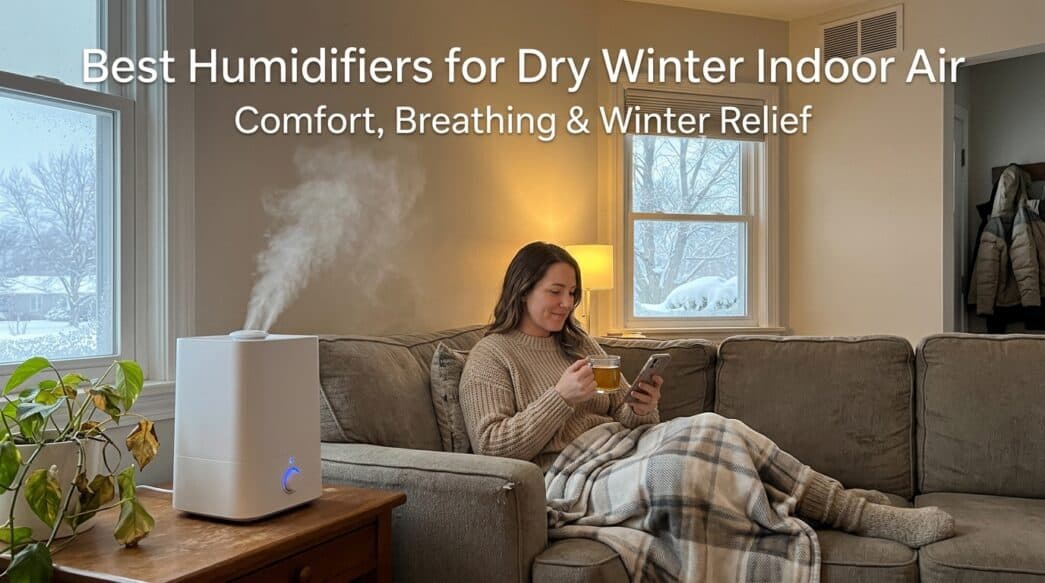
Winter heating is brutally effective at drying out indoor air. As your furnace or heat pump warms cold outdoor air, the relative humidity inside your home can drop into the teens or single digits, even though it felt comfortable outside before the cold front hit. That dry air shows up as chapped lips, dry skin, nosebleeds, worse static shocks, and irritated sinuses. Over time it also dries out wood floors, furniture joints, and musical instruments, which can lead to cracking and gaps that wouldn’t happen at a healthier humidity level.
Most experts recommend keeping indoor relative humidity somewhere between 30% and 50%, with many landing on a 35–45% sweet spot for winter comfort without risking window condensation or mold. Getting there usually means one of two approaches: a portable humidifier you place in a specific room, or a whole-house system that ties directly into your furnace or HVAC ductwork. These solve different problems and involve very different buying decisions, so this guide is split into both categories to help you find the right fit.
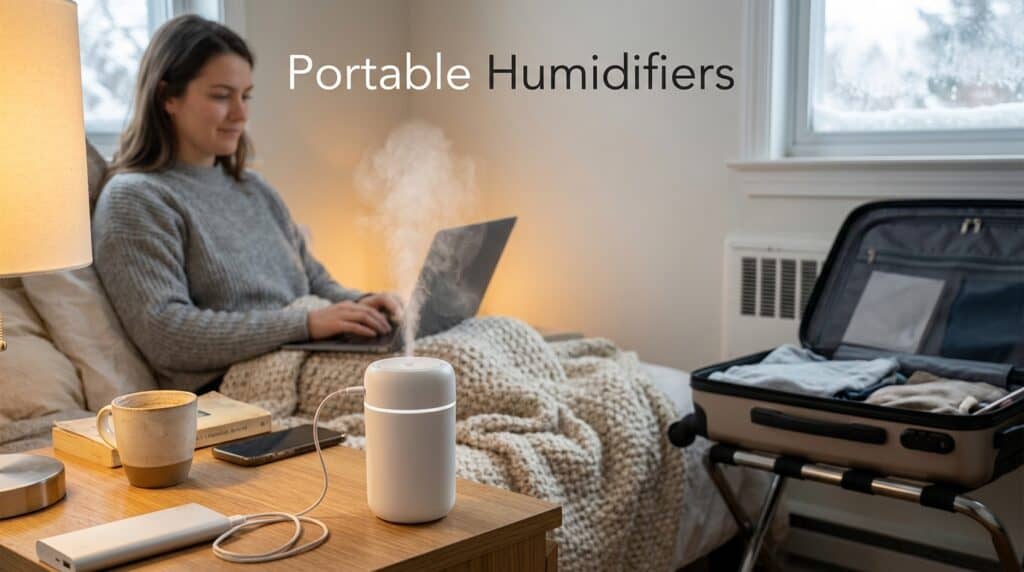
Quick Comparison: Portable Humidifiers
| Product | Best For | Coverage Area | Tank Size | Mist Type |
|---|---|---|---|---|
| LEVOIT OasisMist 1000S | Best for large rooms, longest runtime | Up to 600 ft² | 10L | Ultrasonic cool mist |
| LEVOIT OasisMist 4.5L | Best smart bedroom pick | Medium to large bedroom | 4.5L | Warm & cool mist |
| DREO 16L Smart Humidifier | Best for large open rooms | Up to 1,000 ft² | 16L | Ultrasonic cool mist |
| Lacidoll 26L Large Room Humidifier | Best largest-capacity portable | Up to 3,000 ft² | 26L / 6.8Gal | Ultrasonic cool mist |
| Canopy Large Room Humidifier | Best design-forward, tap-water-safe pick | Up to 1,000 ft² | 5.5L | Evaporative with UV treatment |
| Vitruvi Cloud Bedside Humidifier | Best design pick for nightstand use | Up to 600 ft² | 1.5L | Ultrasonic cool mist |
| Afloia Air Purifier and Humidifier Combo | Best 2-in-1 pick | Room-sized | Top-fill tank | Evaporative, mist-free |
Quick Comparison: Whole-House Systems
| Product | Best For | Output | Installation Type | Professional Install Required |
|---|---|---|---|---|
| AprilAire 600 | Best for most homes | Up to ~16–17 GPD | Bypass (furnace airflow, no electrical circuit) | Yes |
| AprilAire 800 | Best for large or very dry homes | Up to 34.6 GPD | Steam (dedicated electrical circuit) | Yes |
| GeneralAire Model 5500 | Best alternative to AprilAire 800 | Up to 28.5 GPD | Steam (dedicated 230V circuit) | Yes |
Portable Room Humidifiers
1. LEVOIT OasisMist 1000S — Best for Large Rooms, Longest Runtime

The OasisMist 1000S is Levoit’s large-capacity tower humidifier, built for open living rooms and bigger bedrooms rather than a small nightstand. Its 10-liter tank delivers up to 100 hours of continuous mist before needing a refill, and it covers up to 600 square feet with a mist height of over 2 feet, so it actually reaches across a larger room instead of just dampening the air immediately around it.

Smart features run through the VeSync app, where you can set a target humidity level and let Auto Mode maintain it, schedule run times, and even get plant care reminders if you’re using it to keep houseplants happy through a dry winter. The top-fill design means no flipping a heavy tank upside down to refill it, and a built-in demineralization filter helps cut down on mineral buildup over time.

As with most ultrasonic humidifiers, distilled or purified water is recommended to avoid the fine white mineral dust that tap water can leave on nearby furniture. If you’re humidifying a large bedroom or open living space and want long stretches between refills, this is one of the strongest portable options available.
Best for: Large bedrooms or open living spaces that need long runtime between refills.
2. LEVOIT OasisMist 4.5L — Best Smart Bedroom Pick

This Levoit model splits the difference between a compact nightstand humidifier and a full large-room unit. Its 4.5-liter tank is sized for a standard to large bedroom, and it offers both warm and cool mist settings, so you can switch between a soothing warm vapor on a cold night or a cool, lower-energy mist depending on your preference.

Smart control through the VeSync app lets you build schedules that match your routine, so the humidifier can switch on automatically before you wake up or get home, rather than needing to be turned on manually every time. The top-fill design keeps refills simple, and the wide tank opening makes it easy to clean thoroughly, which matters since humidifier tanks need regular attention to avoid mold and mineral buildup.

It’s a solid middle-ground choice: more capable than an entry-level bedroom humidifier, without the bulk or price of a dedicated large-room unit. For most bedrooms, the 4.5-liter tank should comfortably get you through a full night without running dry.
Best for: Bedrooms where you want app-based scheduling and the choice between warm and cool mist.
3. DREO 16L Smart Humidifier — Best for Large Open Rooms
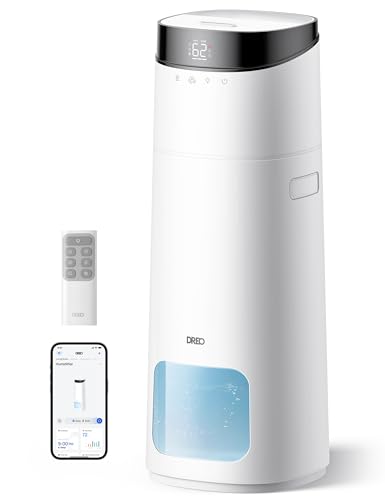
When a bedroom-sized humidifier isn’t going to cut it, the Dreo 16L steps up to genuinely large-room performance. It’s rated for spaces up to 1,000 square feet, with a tall 6-foot mist plume and 400 mL/h output designed to humidify open-concept living rooms or finished basements evenly rather than just creating a damp spot near the unit.

The 16-liter tank is genuinely large, providing up to 130 hours of continuous runtime, which means you could realistically go nearly a week between refills depending on your settings. Control options are flexible too, with app, voice assistant, remote, and touch controls all available, plus a ±5% accurate humidity sensor and a self-cleaning tank designed to cut down on the algae and buildup that can plague large-capacity humidifiers.

A replaceable demineralization cartridge helps manage hard water mineral content, and is recommended for monthly replacement. For anyone trying to humidify a large open floor plan without installing anything into their HVAC system, this is one of the most capable portable options on the market.
Best for: Open-concept living rooms or large finished basements that need real coverage.
4. Lacidoll 26L Large Room Humidifier — Best Largest-Capacity Portable

The Lacidoll is the largest-capacity portable unit in this lineup, with a 26-liter (6.8-gallon) tank and a maximum output of 1,800 mL/h. The manufacturer markets it for spaces up to 3,000 square feet, which is worth a quick clarification: this is a large-capacity portable humidifier, not a furnace-integrated whole-house system like the AprilAire or GeneralAire units further down this list. It’s the closest a plug-in unit gets to whole-floor coverage without any installation, but it still works as a standalone room appliance.

It runs for over 40 hours on a full tank, adjusts humidity from 40% to 90%, and includes a 360° rotating nozzle with an extension tube, which is genuinely useful if you’re using it for a mix of general room humidification and directing moisture toward specific plants. Four wheels make it easy to roll between rooms, and since it’s a filter-free ultrasonic design, there’s no replacement filter cost to budget for.

At under 35dB, it’s quiet enough for bedroom use despite its size, and it includes a night light and up to 12-hour timer for overnight operation. If you want the largest tank and longest runtime available in a portable unit, this is the one to get.
Best for: Buyers who want the largest possible portable tank capacity and runtime without HVAC installation.
5. Canopy Large Room Humidifier — Best Design-Forward, Tap-Water-Safe Pick
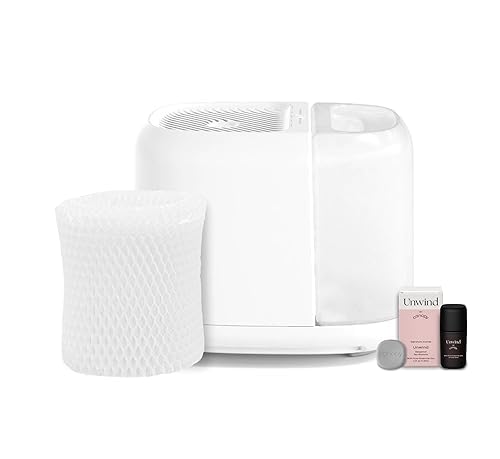
Canopy takes a genuinely different technical approach than most of the other portable units here. Instead of ultrasonic misting, it uses an evaporative method paired with UV-treated water and an antimicrobial filter, which means it’s designed to work well with regular tap water rather than requiring distilled water to avoid white mineral dust. For a lot of buyers, that alone is worth the switch.

The 5.5-liter tank covers up to 1,000 square feet and runs up to 36 hours per fill. Smart sensors keep the unit running until the tank is fully empty rather than shutting off with water still inside, which is a deliberate design choice to reduce the standing water that leads to mold growth. Every part that touches water, including the tank, tray, and cap, is dishwasher-safe, which makes the recommended weekly deep clean far less of a chore than it is with most humidifiers.

It also has a genuinely attractive, modern design that doesn’t look like a medical device sitting in your living room, which matters if appearance is part of your decision. The tradeoff is a filter that needs periodic replacement, generally every 5–7 weeks, but that’s a reasonable cost for the cleaning convenience and tap-water compatibility you get in return.
Best for: Buyers who want an attractive large-room humidifier that’s easy to deep-clean and works fine with regular tap water.
6. Vitruvi Cloud Bedside Humidifier — Best Design Pick for Nightstand Use

Vitruvi built its reputation on beautifully designed essential oil diffusers, and the Cloud humidifier brings that same aesthetic sensibility to a bedside humidifier. Its sculpted, organic shape looks more like a piece of décor than an appliance, which is exactly the point for buyers who want function without sacrificing how their nightstand looks.

It’s genuinely one of the quietest humidifiers available, rated at just 26.8dB, which is a real consideration for light sleepers who notice even a faint hum. The 1.5-liter tank covers up to 600 square feet and runs for up to 24 hours on the lowest setting, with a removable, dishwasher-safe water bucket that slides out with a built-in handle instead of requiring you to flip the whole unit over to refill it.

The tradeoff for that compact, design-forward footprint is tank size: at 1.5 liters, you’ll be refilling it more often than the larger units on this list, especially on higher mist settings. If your priority is a humidifier that looks genuinely good on a nightstand and runs whisper-quiet through the night, the size tradeoff is a reasonable one to make.
Best for: Light sleepers and anyone who wants a humidifier that doubles as bedside décor.
7. Afloia Air Purifier and Humidifier Combo — Best 2-in-1 Pick
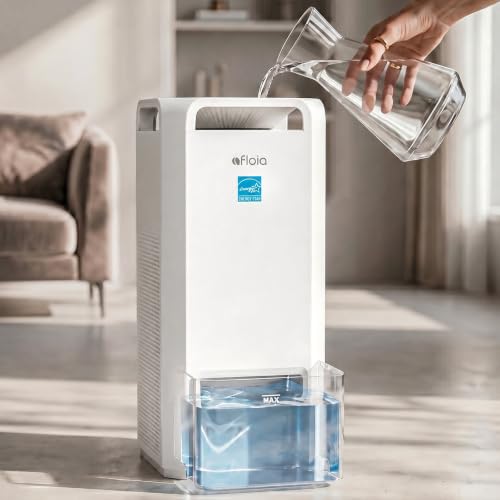
Winter doesn’t just bring dry air, it also means windows stay shut for months, which lets dust, pet dander, and other indoor allergens build up indoors with nowhere to go. The Afloia combo unit tackles both problems at once, pairing a multi-stage filtration system (typically a prefilter, activated carbon layer, and HEPA-grade filter across Afloia’s combo lineup) with a mist-free, evaporative humidifier module built into the same machine.

Because the humidification side uses evaporative technology rather than ultrasonic misting, it produces no visible mist and no white mineral dust on nearby surfaces, just clean, evenly distributed moisture in the air. A top-fill tank design makes refilling simple, and most models in this Afloia line include an auto shut-off, multiple fan speeds, and a filter-replacement indicator light so you know when it’s time for new filters, generally every 3–6 months depending on use.

It’s worth knowing going in that on Afloia’s combo units, the humidifier module is generally designed to run alongside the air purifier rather than fully independently, so check the specific listing for your model’s exact operating notes. For anyone dealing with both dry winter air and indoor allergens at the same time, getting both functions from one machine is a real space and cost saver compared to buying two separate appliances.
Best for: Households dealing with both dry winter air and indoor allergens like dust, pet dander, or smoke.
Whole-House Systems
The three products below are fundamentally different from everything above. Instead of a plug-in appliance you place in a room, these mount directly to your home’s furnace or HVAC ductwork and humidify your entire home through your existing air distribution system. That comes with real tradeoffs worth understanding before you buy:
- Professional installation is required. All three of these units need to be installed by a qualified HVAC contractor. DIY installation typically voids the manufacturer’s warranty.
- Installation costs vary significantly by type. Bypass-style humidifiers (like the AprilAire 600) that use your furnace’s existing airflow generally cost less to install than steam units, which require a dedicated electrical circuit.
- Annual maintenance is still required. Bypass units need an annual water panel (pad) replacement; steam units need an annual steam cylinder or canister replacement.
- The payoff is consistent, whole-home humidity without carrying water tanks to the sink or worrying about a unit running dry overnight, since these connect directly to your home’s plumbing.
8. AprilAire 600 Whole-House Humidifier — Best for Most Homes

The AprilAire 600 is a bypass-style humidifier, meaning it uses your furnace’s existing blower to pull warm air through a water-saturated evaporator pad, adding moisture to the air your HVAC system already circulates. Because it doesn’t need its own electrical circuit, it’s generally less expensive to install than a steam unit, which makes it the right starting point for most homeowners considering a whole-house system for the first time.

It’s rated to add roughly 16–17 gallons of humidity per day, which covers homes up to about 3,000 square feet under typical conditions (less in older, leakier homes, since infiltration of dry outside air increases the humidification load). AprilAire generally recommends plumbing these bypass units to a hot water line for best performance, which your HVAC contractor will set up during installation.

Maintenance is genuinely minimal: the water panel inside needs replacement roughly once a year, typically at the start of the heating season, and that’s the main upkeep task for the system’s entire lifespan. Industry estimates put installed cost for AprilAire’s bypass models (including the 600) in the range of roughly $720 to $1,440, though your actual cost will depend on your specific HVAC setup and local labor rates.
Best for: Most homes up to roughly 3,000 sq ft looking for a cost-effective entry point into whole-house humidification.
9. AprilAire 800 Whole-House Steam Humidifier — Best for Large or Very Dry Homes
No products found.The AprilAire 800 is a different category of product from the bypass-style 600. It’s a steam humidifier, meaning it heats water to generate steam directly rather than relying on your furnace’s airflow to evaporate moisture from a pad. That gives it a dramatically higher output, rated up to 34.6 gallons per day, and the ability to humidify effectively even in homes with very dry conditions where evaporative bypass units sometimes struggle to keep up.
No products found.Because it produces steam through an electric heating process rather than airflow evaporation, the 800 requires a dedicated electrical circuit, which is the main reason installation costs are meaningfully higher than the 600. Industry estimates generally place installed cost for the 800 in the range of roughly $1,800 to $4,200, reflecting both the electrical work involved and the more complex installation overall.
No products found.Ongoing maintenance includes an annual steam canister replacement, which is a real recurring cost to factor in beyond the initial installation. For large homes (roughly 4,000+ square feet) or homes in especially arid climates where a bypass unit just can’t add moisture fast enough, the 800’s much higher output makes it the right tool for the job despite the higher upfront and maintenance costs.
Best for: Large homes over roughly 4,000 sq ft, or any home in a very dry climate where evaporative systems fall short.
10. GeneralAire Model 5500 Steam Humidifier — Best Alternative to AprilAire 800

The GeneralAire 5500 is an electrode steam humidifier that’s frequently compared directly against the AprilAire 800 by HVAC professionals, and it’s worth a look as a second opinion if you’re already shopping in the steam-unit category. It produces steam by passing electrical current directly through water between metal electrodes, and its output scales with your home’s electrical service: up to roughly 15 gallons per day on a 115V circuit, or up to 28.5 gallons per day on a 230V circuit.

It’s rated for homes up to 5,500 square feet on the higher-voltage setup, and like the AprilAire 800, it requires a dedicated electrical circuit, typically a 230V/20A circuit for the higher-output configuration. It includes a digital humidistat control (the GFX4 or GFX5, depending on version) that can also control your furnace’s blower motor for more consistent humidity delivery throughout the home.

One genuinely useful design detail: the same unit works on either 115V or 230V power through an internal switch, so your HVAC contractor has flexibility depending on what’s available at the install location. Like all steam humidifiers, it needs an annual cylinder replacement, and professional installation is required to keep the manufacturer’s warranty intact.
Best for: Buyers comparison-shopping steam humidifiers who want a strong alternative to the AprilAire 800.
Which Humidifier Fits Your Situation?
If you want a simple, quiet bedroom humidifier: The Vitruvi Cloud or LEVOIT OasisMist 4.5L both deliver reliable bedroom-scale humidification without unnecessary complexity.
If you want smart app-based control with a long runtime: The LEVOIT OasisMist 1000S covers large rooms for up to 100 hours between refills.
If you need to cover a large open room or finished basement: The DREO 16L or Lacidoll 26L both deliver genuine large-space coverage without any installation.
If you want a humidifier that works well with tap water and looks good doing it: The Canopy’s evaporative, UV-treated design and dishwasher-safe parts stand out here.
If you’re also dealing with winter indoor air quality or allergens: The Afloia combo unit tackles both humidification and filtration in one machine.
If you want consistent humidity in every room and are ready for a contractor visit: The AprilAire 600 is the most cost-effective entry point into whole-house humidification.
If you have a large home or live somewhere especially arid: The AprilAire 800 or GeneralAire 5500 deliver dramatically higher output for homes that need it.
What to Look for in a Winter Humidifier
Portable vs. Whole-House: Which Do You Actually Need?
If you mainly want to fix dryness in a bedroom, home office, or living room, a portable unit is almost always the simpler and cheaper answer. Whole-house systems make the most sense if you’re chasing consistent humidity throughout an entire home, want to stop carrying water tanks to the sink altogether, or are already working with an HVAC contractor on other furnace-related projects.
Target Humidity Range
Most guidance points to keeping indoor relative humidity between 30% and 50%, with many sources recommending a tighter 35–45% range in winter specifically. Too low, and you’re back to dry skin and static. Too high, and you risk window condensation and conditions that encourage mold growth, so more humidity isn’t automatically better.
Ultrasonic vs. Evaporative Mist
Ultrasonic humidifiers use high-frequency vibration to create a fine mist and tend to be quieter, but they generally require distilled or purified water to avoid leaving fine white mineral dust on nearby surfaces. Evaporative humidifiers pull air through a wet wick or filter and release invisible water vapor; they’re often more forgiving of tap water but require regular filter replacement.
Tank Size and Refill Frequency
Larger tanks mean fewer refills but a bigger, heavier unit to manage and clean. Match tank size to how often you’re realistically willing to refill and clean the unit, since a humidifier that’s a hassle to maintain tends to get used less consistently.
Installation and Ongoing Costs for Whole-House Systems
Beyond the unit price, budget for professional installation (which varies significantly based on whether you’re choosing a bypass or steam system) and ongoing annual maintenance, whether that’s a water panel or a steam canister replacement.
Cleaning and Mold Prevention
Portable humidifier tanks should generally be emptied and rinsed daily, with a deeper clean weekly, to prevent mold and bacterial growth in standing water. Whole-house systems are far lower-maintenance day to day, but still need that annual professional service to stay running cleanly.
A Quick Note on Balance
More humidity isn’t automatically better. Pushing indoor humidity above roughly 50%, especially in a tightly sealed winter home, can encourage mold growth and dust mites and lead to condensation on windows and cold surfaces. A humidistat or simple hygrometer is a worthwhile addition to any humidification setup so you can monitor actual levels rather than guessing. This article covers general home-comfort information, not medical advice; if you or someone in your household has ongoing respiratory issues, it’s worth discussing humidity recommendations specific to your situation with a doctor.
Frequently Asked Questions
What humidity level is ideal for a home in winter?
Most guidance recommends keeping indoor relative humidity between 30% and 50%, with many experts suggesting a tighter 35–45% range during winter to balance comfort against the risk of window condensation.
What’s the difference between an ultrasonic and an evaporative humidifier?
Ultrasonic humidifiers use vibration to create a fine mist and tend to run quietly, but usually need distilled water to avoid mineral dust. Evaporative humidifiers pull air through a wet filter or wick to release invisible vapor, generally tolerate tap water better, but require periodic filter replacement.
Can a portable humidifier really cover a whole house?
Some large-capacity portable units are marketed with “whole house” language and can meaningfully raise humidity across an open floor plan, but they’re still single-location appliances treating the air around them rather than distributing moisture evenly to every room the way a furnace-integrated system does.
Do whole-house humidifiers need a plumber or electrician to install?
Yes. Whole-house humidifiers like the AprilAire and GeneralAire models mount to your HVAC system and typically involve water line connections and, for steam models, dedicated electrical circuits. Professional installation by a qualified HVAC contractor is required to keep the manufacturer’s warranty valid.
How often should I clean my humidifier?
Portable humidifier tanks generally should be emptied and rinsed daily, with a more thorough cleaning weekly, to prevent mold and bacterial growth. Whole-house systems need far less frequent attention, generally just an annual water panel or steam canister replacement.
Can running a humidifier damage my walls or windows?
Running a humidifier at appropriate levels (generally 30–50% relative humidity) shouldn’t cause damage. Problems tend to arise when humidity is pushed too high for the home’s insulation and window quality, which can lead to condensation, and over time, mold or moisture damage near cold surfaces.
Final Verdict
| Category | Pick |
|---|---|
| Best for Large Rooms, Longest Runtime | LEVOIT OasisMist 1000S |
| Best Smart Bedroom Pick | LEVOIT OasisMist 4.5L |
| Best for Large Open Rooms | DREO 16L Smart Humidifier |
| Best Largest-Capacity Portable | Lacidoll 26L Large Room Humidifier |
| Best Design-Forward, Tap-Water-Safe Pick | Canopy Large Room Humidifier |
| Best Design Pick for Nightstand Use | Vitruvi Cloud Bedside Humidifier |
| Best 2-in-1 Pick | Afloia Air Purifier and Humidifier Combo |
| Best Whole-House System for Most Homes | AprilAire 600 |
| Best for Large or Very Dry Homes | AprilAire 800 |
| Best Alternative Steam System | GeneralAire Model 5500 |
Whether you go with a simple bedside unit or a furnace-integrated whole-house system, the goal is the same: keep your winter indoor air in a healthy, comfortable range without overcorrecting into the conditions that come with too much moisture.