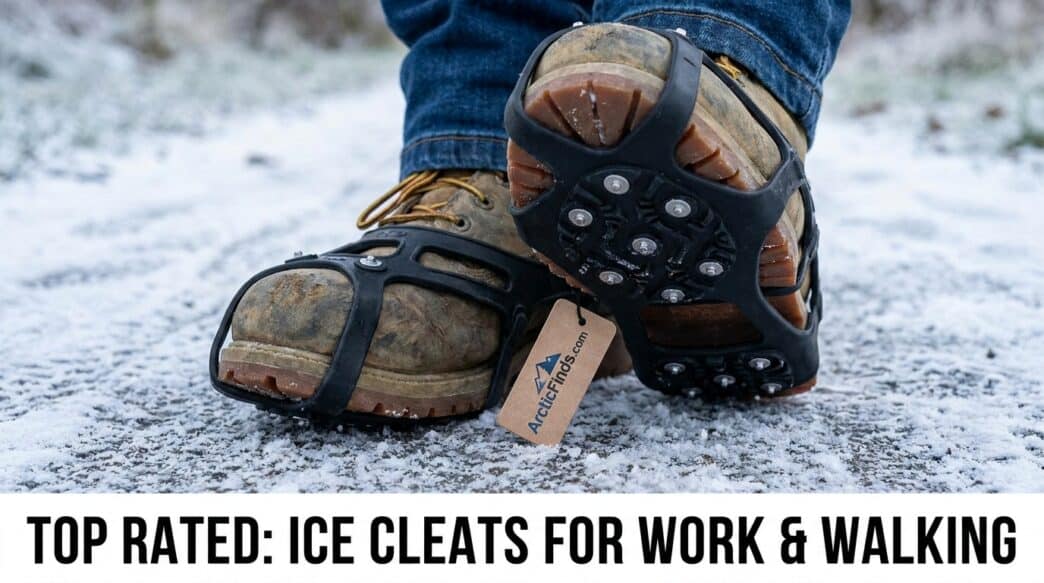
The best ice cleats for you depend on the ice you actually walk on. Coils are great on packed snow but skate on glare ice. Tungsten carbide studs bite into hard ice and last for seasons. Chain-and-spike designs grip steep, icy trails but are awkward on bare pavement. And if you drive or climb ladders for work, you want cleats that leave the front of your boot free.
We compared 10 ice cleats on Amazon, from a $10 budget pair to $90 trail spikes, by traction type, stud or spike count, coverage, price and owner ratings. Specs come from each brand’s Amazon listing, and ratings were checked on October 25, 2026. Jump to the “where do you walk” picker.
Quick picks
- Best overall: ICETRAX V3 Tungsten ($23.74)
- Best for everyday sidewalks: Yaktrax Walk ($21.15)
- Best for active walking and running: Yaktrax Pro ($29.99)
- Best for shoveling and dog walks: STABILicers Walk ($36.99)
- Best budget: Sfee 10-Stud Ice Cleats ($9.98)
- Best for icy parking lots: Yaktrax Diamond Grip ($49.99)
- Best heavy-duty for work: Winter Walking Low-Pro ($54.95)
- Best for drivers and ladders: K1 Series Mid-Sole ($31.89)
- Best for steep trails: Kahtoola MICROspikes ($89.95)
- Best budget microspike alternative: SYOURSELF Crampons ($22.99)
Ice cleat comparison table
| Model | Traction type | Key spec | Coverage | Price |
|---|---|---|---|---|
| ICETRAX V3 Tungsten | Studs | 9 tungsten carbide studs, StayON toe cap | Full foot | $23.74 |
| Yaktrax Walk | Coils | 360° steel coils | Full foot | $21.15 |
| Yaktrax Pro | Coils | 1.4mm stainless coils, top strap | Full foot | $29.99 |
| STABILicers Walk | Steel plates | Heat-treated steel plates, flexible to -45°F | Full foot | $36.99 |
| Sfee 10-Stud | Studs | 10 steel studs | Full foot | $9.98 |
| Yaktrax Diamond Grip | Beads | Case-hardened steel diamond beads | Full foot | $49.99 |
| Winter Walking Low-Pro | Studs | 26 tungsten carbide studs | Full foot | $54.95 |
| K1 Series Mid-Sole | Studs | 10 tungsten carbide spikes, rotates up | Mid-sole only | $31.89 |
| Kahtoola MICROspikes | Spikes and chains | 12 stainless spikes per foot | Full foot | $89.95 |
| SYOURSELF Crampons | Spikes and chains | 12 stainless spikes per foot | Full foot | $22.99 |
Where do you walk? A quick picker
| Where you walk | Best traction type | Our picks |
|---|---|---|
| Sidewalks, driveways, dog walks | Coils, plates or light studs | Yaktrax Walk, STABILicers Walk, Sfee 10-Stud |
| Icy parking lots and glare ice | Tungsten studs or beads | ICETRAX V3 Tungsten, Yaktrax Diamond Grip |
| Job sites and long shifts | Tungsten carbide studs | Winter Walking Low-Pro, ICETRAX V3 Tungsten |
| Delivery routes, driving, ladders | Mid-sole studs | K1 Series Mid-Sole |
| Trails and steep, icy ground | Spikes and chains | Kahtoola MICROspikes, SYOURSELF Crampons |
Coils vs studs vs spikes vs beads
Every ice cleat uses one of four ways to grip. Here’s how they generally compare. This is a quick guide, not a lab test, and real grip also depends on fit and the exact surface.
| Type | Glare ice | Packed snow | Bare pavement | Best for |
|---|---|---|---|---|
| Coils (Yaktrax Walk, Pro) | Fair | Good | Comfortable | Sidewalks with packed snow |
| Studs (ICETRAX, Low-Pro, K1, Sfee) | Good to very good | Good | Fine, a little noisy | Icy lots, work, mixed surfaces |
| Beads and plates (Diamond Grip, STABILicers) | Good | Good | Fine | Everyday walking on mixed ice and snow |
| Spikes and chains (MICROspikes, SYOURSELF) | Very good | Very good | Awkward | Trails, hills, deep or rutted ice |
Tungsten carbide is much harder than regular steel, so tungsten studs stay sharp for longer on concrete and asphalt. That’s why work-focused cleats use it.
Best ice cleats for everyday walking
1. ICETRAX V3 Tungsten: Best Overall
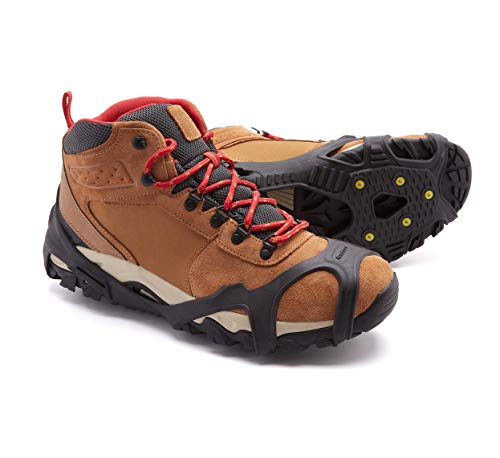
Verdict: Tungsten studs, a toe cap that stays put, and a low price. The right pair for most people.
Key specs: 9 tungsten carbide studs, snow tread traction pattern, StayON toe cap, reflective details. Designed in Canada.
The ICETRAX V3 hits the sweet spot between everyday comfort and real grip on hard ice. The tungsten carbide studs are the same hard material used in work-grade cleats, so they bite into glare ice and hold up on bare pavement between icy patches.
The StayON toe cap is the feature owners care about most. Cheap stretch cleats tend to slide off the front of a boot after a few steps. The toe cap locks the front in place. With over 8,000 reviews at 4.7 stars, it’s the most-liked pick on this list.

Pros:
- Tungsten carbide studs grip glare ice
- Toe cap stops the cleats sliding off
- Reflective for dark mornings
- Low price for tungsten
Cons:
- Only 9 studs, fewer than heavy-duty work models
- Not designed for steep trails
Skip it if: you hike icy trails. Chain-and-spike designs grip better on slopes.
Owner rating: 4.7 out of 5 from about 8,070 Amazon reviews (Amazon, retrieved 2026-10-25).
Check the ICETRAX V3 price on Amazon
2. Yaktrax Walk: Best for Everyday Sidewalks

Verdict: The classic, budget-friendly pick for packed snow on sidewalks and driveways.
Key specs: Steel coils for 360° grip, thermoplastic rubber sling rated not to crack in cold temperatures, heel tab for easy on and off.
With more than 27,000 reviews, the Yaktrax Walk is probably the best-known ice cleat in the US. The coils wrap under the whole foot, giving even grip forward, backward and sideways on snow-packed paths. The heel tab makes them easy to pull on, which matters if bending down is hard.
Be clear about what coils can do. They’re great on packed snow and rough ice, but they don’t bite into smooth glare ice the way studs do. For black ice on a parking lot, pick a studded model.

Pros:
- Low price and huge owner base
- Comfortable on bare pavement
- Easy heel tab
- Even grip in every direction
Cons:
- Coils are weaker than studs on glare ice
- No top strap, so they can shift on fast walks
Skip it if: your route is mostly smooth ice. Go for the ICETRAX or Diamond Grip.
Owner rating: 4.4 out of 5 from about 27,200 Amazon reviews (Amazon, retrieved 2026-10-25).
Check the Yaktrax Walk price on Amazon
3. Yaktrax Pro: Best for Active Walking and Running
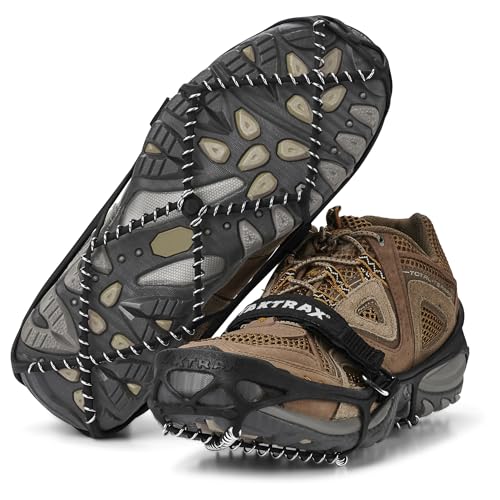
Verdict: The Yaktrax Walk with thicker coils and a strap that keeps it on at speed.
Key specs: 1.4mm stainless-steel coils from heel to toe, recyclable thermoplastic rubber upper rated not to crack in the cold, performance strap over the top of the foot, heel tab.
The Pro is for brisk walkers and winter runners. The extra strap across the top of the foot is the big difference from the Walk. It stops the cleat shifting when you push off hard or change direction.
The stainless coils are thicker too, so they last longer on mixed snow and pavement. It still uses coils, so the same glare-ice limit applies.

Pros:
- Top strap keeps it secure on fast walks and runs
- Thicker stainless coils
- Over 15,000 reviews
- Light and comfortable
Cons:
- Coils still struggle on glare ice
- Costs more than the Walk
Skip it if: you walk slowly on smooth ice. Studs are the safer choice.
Owner rating: 4.3 out of 5 from about 15,200 Amazon reviews (Amazon, retrieved 2026-10-25).
Check the Yaktrax Pro price on Amazon
4. STABILicers Walk: Best for Shoveling and Dog Walks

Verdict: Full-sole steel plates for mixed ice and snow on everyday chores.
Key specs: Heat-treated steel traction plates in the heel and forefoot, stretch-to-fit thermoplastic binding, full-sole coverage, tested to stay flexible down to -45°F.
STABILicers built the Walk for the jobs you do around the house: walking the dog, getting the mail and shoveling the driveway. The steel plates sit in both the heel and the forefoot, so you get grip whether you’re stepping forward or bracing to push a shovel.
The binding is rated to stay flexible down to -45°F, which makes it easier to pull on in deep cold than stiffer rubber cleats.

Pros:
- Heel and forefoot plates for stable footing while shoveling
- Stays flexible in extreme cold
- Over 8,600 reviews
- Full-sole coverage
Cons:
- Bulkier than coil cleats
- Plates aren’t tungsten, so expect more wear on bare concrete
Skip it if: you mainly walk long stretches of bare pavement.
Owner rating: 4.4 out of 5 from about 8,680 Amazon reviews (Amazon, retrieved 2026-10-25).
Check the STABILicers Walk price on Amazon
5. Sfee 10-Stud Ice Cleats: Best Budget

Verdict: A basic studded pair for around $10, good to keep in the car or by the door.
Key specs: 10 steel studs, anti-slip rubber overshoe.
Not everyone needs a premium pair. The Sfee cleats are a simple rubber overshoe with 10 steel studs. They’re good for occasional icy days, a spare pair in the car, or a guest at the front door.
For the price, you give up some durability. The studs are regular steel rather than tungsten, and the rubber won’t last as long as the big brands.

Pros:
- Very low price
- Studs grip better than coils on hard ice
- Good backup pair
- Over 3,000 reviews
Cons:
- Steel studs wear faster than tungsten
- Not built for daily heavy use
Skip it if: you’ll wear them every day all winter.
Owner rating: 4.4 out of 5 from about 3,200 Amazon reviews (Amazon, retrieved 2026-10-25).
Check the Sfee 10-Stud price on Amazon
Best ice cleats for work
On the job, ice cleats need to last a full shift, survive concrete and asphalt, and fit over work boots. Always check your employer’s safety rules too. Some sites require specific traction devices, and others ban cleats indoors. For the rest of your winter work kit, see our guides to winter work gloves and keeping your toes warm in work boots.
6. Yaktrax Diamond Grip: Best for Icy Parking Lots

Verdict: Full-foot beads that grip glare ice, for workers who cross big icy lots.
Key specs: Case-hardened steel alloy diamond beads strung on aircraft-grade steel cable, swiveling grip points across the whole sole, cold-resistant natural rubber band that stays flexible below zero.
The Diamond Grip is Yaktrax’s answer to glare ice. Instead of coils, it uses hard, faceted beads that swivel as you walk, so there’s always an edge biting into the surface. Grip points run the full length of the foot.
That makes it a strong pick for nurses, retail staff and office workers who cross a sheet of ice in the parking lot every morning. It’s also a good choice for older walkers who want full-foot coverage.

Pros:
- Beads grip glare ice much better than coils
- Full-length traction
- Rubber stays flexible in deep cold
- Strong 4.5-star rating
Cons:
- Costs more than most everyday cleats
- Beads are slippery on smooth indoor floors, so take them off at the door
Skip it if: you mostly walk on packed snow, where the cheaper Yaktrax Walk is enough.
Owner rating: 4.5 out of 5 from about 1,940 Amazon reviews (Amazon, retrieved 2026-10-25).
Check the Yaktrax Diamond Grip price on Amazon
7. Winter Walking Low-Pro: Best Heavy-Duty for Work
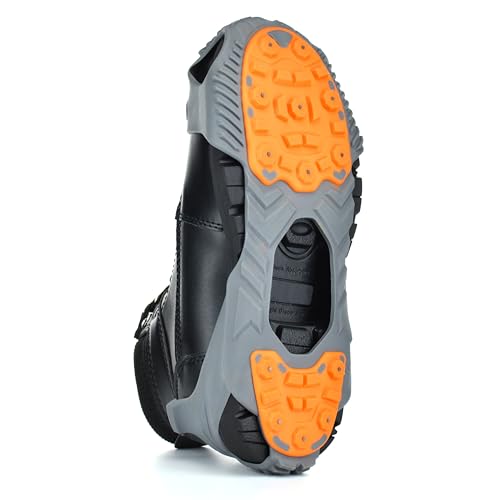
Verdict: Industrial-grade cleats with 26 tungsten studs, built for full shifts on ice.
Key specs: 26 permanent tungsten carbide studs, minimally exposed studs for walking between ice and bare ground, patent-pending dual elasticity (stretchy upper, tougher sole).
Winter Walking makes ice cleats for workplaces, and the Low-Pro shows it. With 26 tungsten carbide studs, it has nearly three times as many studs as the ICETRAX. The studs sit low, so you can step from ice onto bare concrete without feeling like you’re walking on nails.
The dual-elasticity design makes sense for work. The stretchy upper goes on easily over work boots, while the tougher sole resists wear from asphalt and concrete.

Pros:
- 26 tungsten carbide studs
- Low studs handle mixed ice and pavement
- Tough sole for long shifts
- Easy on and off over work boots
Cons:
- Costs about twice as much as everyday cleats
- Fewer reviews (about 540) than the big consumer brands
Skip it if: you only need cleats a few days a year.
Owner rating: 4.5 out of 5 from about 540 Amazon reviews (Amazon, retrieved 2026-10-25).
Check the Winter Walking Low-Pro price on Amazon
8. K1 Series Mid-Sole: Best for Drivers and Ladders

Verdict: Mid-sole cleats you can flip up, for delivery drivers and anyone in and out of vehicles all day.
Key specs: 10 tungsten carbide spikes per pair, mid-sole design that fills the arch area of the boot, rotates between ice traction and a rubber walking surface for indoors, hi-vis adjustable strap, one size fits most.
Full-foot cleats are a problem when you drive, climb ladders or walk in and out of buildings all day. The K1 sits under the middle of your boot, leaving the toe and heel free for pedals and ladder rungs. When you go inside, you rotate it so the rubber side faces down instead of the spikes.
The hi-vis strap is a nice touch for road and yard work. Because it only fits the mid-sole area, one size fits most boots.

Pros:
- Toe and heel stay free for pedals and ladders
- Rotates for indoor floors
- Tungsten carbide spikes
- Hi-vis strap
Cons:
- Only grips under the middle of the foot, so you need to walk flat-footed
- Fewer spikes than full-foot work cleats
Skip it if: you walk long icy routes. Full-foot coverage is more stable.
Owner rating: 4.5 out of 5 from about 1,150 Amazon reviews (Amazon, retrieved 2026-10-25).
Check the K1 Mid-Sole price on Amazon
Best ice cleats for trails and steep ground
9. Kahtoola MICROspikes: Best for Steep Trails

Verdict: The trail standard for icy hikes, hills and winter ice fishing.
Key specs: 12 heat-treated stainless-steel spikes per foot (8 forefoot, 4 heel), welded stainless chains, elastomer harness with reinforced eyelets, packable.
MICROspikes are what most winter hikers carry. The longer spikes and chains grip icy slopes, rutted ice and packed snow where studs and coils run out of bite. Kahtoola lists winter hiking, ice-trekking, ice fishing and trail running as the main uses.
They’re overkill for a flat city sidewalk and awkward on bare pavement. But if your walk includes a steep driveway, a hillside path or a frozen lake, nothing else on this list grips as well.

Pros:
- Best grip on steep ice and rutted snow
- Durable stainless spikes and chains
- Packs small
- 4.7 stars from 3,500+ reviews
Cons:
- The most expensive pick here
- Uncomfortable on bare pavement
Skip it if: you mostly walk on flat sidewalks.
Owner rating: 4.7 out of 5 from about 3,580 Amazon reviews (Amazon, retrieved 2026-10-25).
Check the Kahtoola MICROspikes price on Amazon
10. SYOURSELF Crampons: Best Budget Microspike Alternative
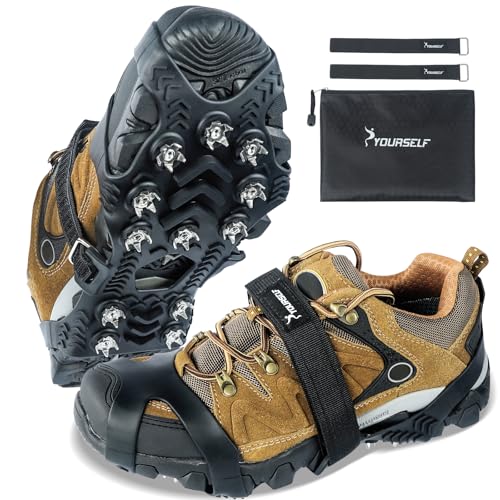
Verdict: A chain-and-spike design for occasional trail use at about a quarter of the price.
Key specs: 12 multi-directional 304 stainless-steel spikes, spacers where the spikes meet the silicone to stop them pulling out, adjustable straps, 3 sizes, carry pouch.
If you hike on ice a few times a winter, the SYOURSELF crampons get you a MICROspikes-style design without the price. The 12 stainless spikes match Kahtoola’s count. The added spacers address the most common failure on cheap crampons, spikes tearing out of the rubber.
The adjustable straps help keep them on, and the three sizes cover kids through large adult boots.

Pros:
- Low price for a chain-and-spike design
- Spacers to stop spikes pulling out
- Straps for a secure fit
- Kids’ to adult sizes
Cons:
- Fewer reviews (about 580) and less proven than Kahtoola
- Awkward on bare pavement, like all spike designs
Skip it if: you hike icy trails every week. The MICROspikes are worth the extra money.
Owner rating: 4.4 out of 5 from about 580 Amazon reviews (Amazon, retrieved 2026-10-25).
Check the SYOURSELF Crampons price on Amazon
How to choose ice cleats
Pick the right traction type
Match the cleat to your surface. Coils for packed snow, studs or beads for glare ice, and spikes and chains for slopes and trails. If your route mixes ice with bare pavement, low tungsten studs are the most comfortable all-rounder.
Size to your boot, not your shoe
Cleats should be sized for the footwear you’ll wear them on. Insulated winter and work boots are often one or two sizes bigger than your street shoes. Check each brand’s size chart against your boot.
A good fit is snug. The cleat shouldn’t twist when you twist your foot, and the toe should sit right at the front of the boot. If it slides off the toe when you walk, go down a size or choose a model with a toe cap or top strap.
Ice cleats at work
- Drivers and ladder work: choose mid-sole cleats like the K1, so pedals and rungs touch rubber, not metal.
- Long shifts on concrete: choose tungsten carbide studs, which wear far more slowly than steel.
- Indoor floors: take cleats off, or rotate them, before walking on tile, polished concrete or metal. Studs and beads can be slippery on smooth hard floors.
- Rules: check your employer’s safety policy. Some workplaces supply or require specific traction devices.
Ice cleats for seniors
For older walkers, ease of use matters as much as grip. Look for a heel tab or a toe cap that makes them easy to pull on. Put cleats on while sitting down, never while standing on ice. Full-foot designs like the Yaktrax Diamond Grip or STABILicers Walk give the most stable footing. And keep a headlamp handy for dark mornings, so you can see the ice before you step on it.
Where cleats don’t help
Ice cleats aren’t a fix for everything. Stairs, wet tile and metal grates can be more slippery with cleats on. Use the handrail, and clear and salt your steps. For icy doorways, a heated snow melting mat stops ice forming in the first place. And clearing snow before it packs down, with a shovel or a cordless snow blower, means less ice to walk on.
Care and replacement
Dry your cleats after each use so the studs and chains don’t rust, and store them somewhere room temperature. Check them at the start of each winter for cracked rubber, loose studs or worn coils. Replace them if the rubber splits or several studs are missing.
Ice cleat FAQ
Do ice cleats really work on black ice?
Studded, beaded and spiked cleats grip black ice well because they press into the surface. Coil designs work better on packed snow than on smooth black ice. Walk with short, flat-footed steps either way.
Can you wear ice cleats indoors?
It’s best not to. Metal studs and beads can scratch floors and may be slippery on smooth tile or polished concrete. Take them off at the door, or use a rotating mid-sole design like the K1.
Can you drive with ice cleats on?
Not with full-foot cleats, which can slip on pedals. Take them off before driving, or use mid-sole cleats that leave the front of your boot free.
What’s the difference between ice cleats and microspikes?
“Ice cleats” usually means studs, coils or beads for walking on flat, icy ground. Microspikes use longer spikes and chains for steep, rough or trail ice. Microspikes grip more on slopes but are less comfortable on pavement.
How do I choose the right size?
Size to the boot you’ll wear them on, using the brand’s size chart. If you’re between sizes, choose the smaller size for a snug fit, unless the chart says otherwise.
Are ice cleats safe on stairs?
Use extra care. Metal traction can slip on hard steps. Hold the handrail, and take cleats off for indoor stairs.
How long do ice cleats last?
It depends on how often you walk on bare pavement. Tungsten carbide studs last the longest, steel studs and coils wear faster, and rubber parts eventually crack. Check them every winter.
Bottom line: which ice cleats should you buy?
- Most people: the ICETRAX V3 Tungsten.
- Packed-snow sidewalks on a budget: the Yaktrax Walk, or the Sfee 10-Stud as a spare pair.
- Icy parking lots: the Yaktrax Diamond Grip.
- Full shifts on ice: the Winter Walking Low-Pro.
- Drivers and ladder work: the K1 Mid-Sole.
- Trails and hills: the Kahtoola MICROspikes, or the SYOURSELF Crampons on a budget.
Buy before the first freeze. Ice cleats are one of the cheapest ways to avoid a winter fall.