
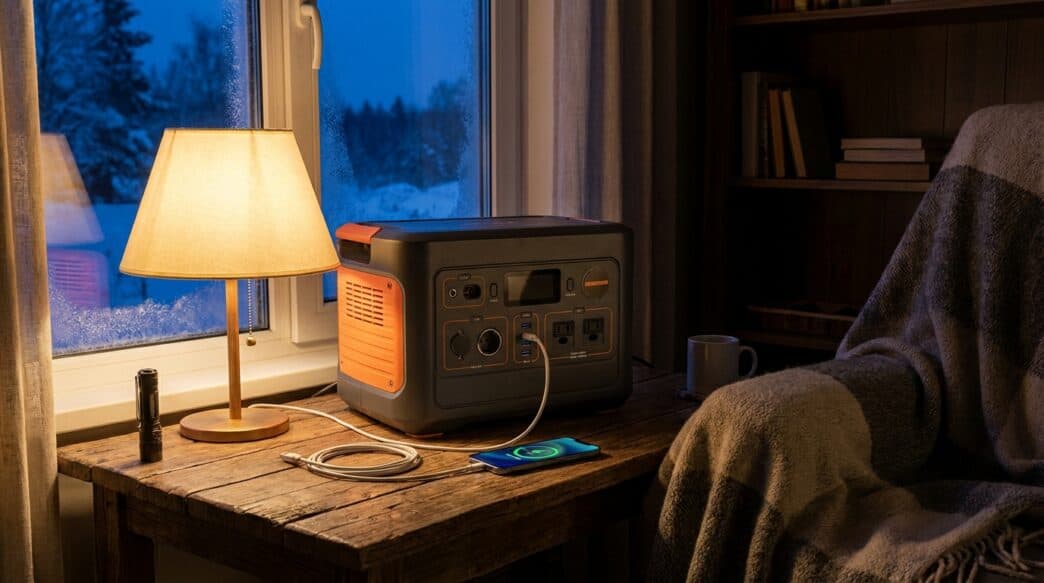
Looking for the best power station for a power outage this winter? Start with what you need to keep running, not the brand. Phones, a router and a few lamps need a small unit. A fridge through a cold night needs about 1,000 watt-hours. Keeping a gas furnace’s blower fan running, so your heat still works, usually means a 2,000 watt-hour station and a safe way to connect it.
Winter outages are harder on backup power than summer ones. You need heat, batteries don’t like the cold, and snow can cover solar panels for days. A battery power station has one big advantage over a gas generator here: it makes no fumes, so you can run it inside your home.
We compared 10 LiFePO4 power stations on Amazon by capacity, output, UPS switchover, recharge speed, cold-weather limits, price and owner ratings. Specs come from each manufacturer’s Amazon listing, and ratings were checked on October 25, 2026. Jump to the “what do you need to run” picker.
Quick picks
- Best overall for most homes: Jackery Explorer 1000 v2 ($559.00)
- Best for fast recharge and UPS: Anker SOLIX C1000 Gen 2 ($499.99)
- Best expandable 1kWh: EcoFlow DELTA 3 ($629.00)
- Best budget 1kWh: BLUETTI AC180 ($499.00)
- Best for priority circuits: Jackery HomePower 1000 Plus v2 ($749.00)
- Best 2kWh value: EcoFlow DELTA 3 Max ($899.00)
- Best expandable home backup: Jackery HomePower 2000 Plus v2 ($1,199.00)
- Best for big startup loads: BLUETTI Elite 200 V2 ($949.00)
- Best for multi-day outages: Jackery HomePower 3000 ($1,499.00)
- Best small unit for CPAP and essentials: EcoFlow RIVER 2 Pro ($439.00)
Power station comparison table
| Model | Capacity | AC output (surge) | UPS switchover | AC recharge | Price |
|---|---|---|---|---|---|
| Jackery Explorer 1000 v2 | 1,070Wh | 1,500W (3,000W) | Not listed | 1 hr (app mode), 1.7 hr default | $559.00 |
| Anker SOLIX C1000 Gen 2 | 1,024Wh | 2,000W (3,000W) | 10ms | 49 min | $499.99 |
| EcoFlow DELTA 3 | 1,024Wh (expands to 5kWh) | 1,800W | Not listed | 56 min | $629.00 |
| BLUETTI AC180 | 1,152Wh | 1,800W (2,700W boost) | 20ms | About 1 hr | $499.00 |
| Jackery HomePower 1000 Plus v2 | 1,024Wh (expands to 11kWh) | 1,800W | Under 10ms | 1.25 hr | $749.00 |
| EcoFlow DELTA 3 Max | 2,048Wh | 2,400W (3,400W X-Boost) | Under 10ms | 0-80% in 1.13 hr | $899.00 |
| Jackery HomePower 2000 Plus v2 | 2,048Wh (expands to 12kWh) | 2,400W | Not listed | Not listed | $1,199.00 |
| BLUETTI Elite 200 V2 | 2,073.6Wh | 2,600W (3,900W power lifting) | Not listed | Not listed | $949.00 |
| Jackery HomePower 3000 | 3,072Wh | 3,600W (7,200W) | 20ms or less | 2.2 hr (1.7 hr AC + DC) | $1,499.00 |
| EcoFlow RIVER 2 Pro | 768Wh | 800W (1,600W X-Boost) | Not listed | 70 min | $439.00 |
What do you need to keep running?
Pick the row that matches the most important thing on your list. Then size up if your outages usually last more than a day.
| What you need to run | Capacity to look for | Our picks |
|---|---|---|
| Phones, Wi-Fi router, lamps | 500-800Wh | EcoFlow RIVER 2 Pro |
| CPAP through the night | 700-1,100Wh | EcoFlow RIVER 2 Pro, Jackery Explorer 1000 v2 |
| Fridge plus essentials for about a day | 1,000-1,200Wh | Jackery Explorer 1000 v2, Anker C1000 Gen 2, EcoFlow DELTA 3, BLUETTI AC180, Jackery HomePower 1000 Plus v2 |
| Gas furnace blower plus fridge | About 2,000Wh | EcoFlow DELTA 3 Max, Jackery HomePower 2000 Plus v2, BLUETTI Elite 200 V2 |
| Multi-day winter storm | 3,000Wh or expandable | Jackery HomePower 3000, or a HomePower 2000 Plus v2 with extra batteries |
Best 1kWh power stations for most homes
A 1kWh (1,000 watt-hour) station is the sweet spot for most households. It can keep a fridge, a router and some lights going through an overnight outage, and one person can carry it.
1. Jackery Explorer 1000 v2: Best Overall for Most Homes

Verdict: The most popular 1kWh station on this list, at a fair price, with fast charging when you need it.
Key specs: 1,070Wh LFP battery, 1,500W AC output (3,000W surge), three pure sine wave AC outlets, two USB-C, one USB-A and a car port. Full charge in 1 hour with emergency charging turned on in the Jackery app (1.7 hours by default). Over 70% capacity after 4,000 cycles.
With more than 3,700 reviews, the Explorer 1000 v2 is the safe choice for a typical home. The 1,070Wh battery is enough for a fridge and a router overnight. The 3,000W surge rating helps when a fridge compressor kicks on.
The one-hour charge matters in winter. When a storm is forecast, you can top it up quickly before the lines go down. It’s also the pick for anyone who wants a station they can move between the kitchen, a bedroom and the car.

Pros:
- Huge owner base and strong ratings
- One-hour emergency charging before a storm
- 3,000W surge handles fridge startup
- Long-life LFP battery
Cons:
- Not expandable, so 1,070Wh is your limit
- The listing doesn’t state a UPS switchover time
Skip it if: you want to run a furnace blower. Look at the 2kWh picks instead.
Owner rating: 4.7 out of 5 from about 3,700 Amazon reviews (Amazon, retrieved 2026-10-25).
Check the Jackery Explorer 1000 v2 price on Amazon
2. Anker SOLIX C1000 Gen 2: Best for Fast Recharge and UPS
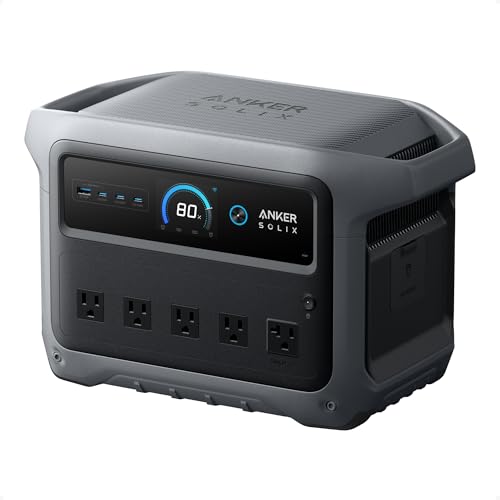
Verdict: The most power per pound in the 1kWh class, with the fastest recharge here.
Key specs: 1,024Wh LiFePO4, 2,000W AC output (3,000W peak), 10 ports, 10ms UPS backup, full recharge in 49 minutes at 1,600W (enabled in the Anker app), 600W solar input (1.8 hours), at least 80% capacity after 4,000 cycles.
The C1000 Gen 2 is the one to leave plugged in all winter. Its 10ms UPS switches to battery fast enough that a Wi-Fi router or desktop computer usually won’t notice the outage. The 2,000W output is higher than most 1kWh stations, so a microwave or coffee maker isn’t a problem.
Anker rates its stations for use down to -4°F, one of the lower limits among the brands here (Backup Power Hub, retrieved 2026-10-25). Like every brand, though, it should only be charged above freezing.

Pros:
- 10ms UPS for routers and computers
- 49-minute recharge
- 2,000W output in a compact case
- Rated for use down to -4°F
Cons:
- Costs more than the Jackery 1000 v2 and BLUETTI AC180
- Not expandable
Skip it if: you only need to charge phones and run lamps. A smaller station costs much less.
Owner rating: 4.7 out of 5 from about 1,760 Amazon reviews (Amazon, retrieved 2026-10-25).
Check the Anker SOLIX C1000 Gen 2 price on Amazon
3. EcoFlow DELTA 3: Best Expandable 1kWh

Verdict: Start at 1kWh now and add batteries later if outages get longer.
Key specs: 1,024Wh LiFePO4, 1,800W AC output, X-Boost for resistive appliances over 2,600W, 13 outlets, full charge in 56 minutes (80% in 30 minutes), 500W solar input, expandable to 5kWh with EcoFlow extra batteries, 4,000 cycles to 80%.
The DELTA 3 makes sense if you’re not sure how much backup you need yet. It works on its own as a 1kWh station, then grows to 5kWh with EcoFlow’s extra battery packs. That’s enough to cover a fridge and essentials for several days.
An 80% charge in 30 minutes is useful during a stop-start outage. If power comes back for an hour, you can refill most of the battery before it goes out again.

Pros:
- Expandable to 5kWh
- Very fast charging
- 13 outlets
- 5-year warranty card in the box, per the listing
Cons:
- Extra batteries add a lot to the total cost
- EcoFlow’s use limit is 14°F, not as low as Anker or BLUETTI
Skip it if: you know you’ll never expand. The Jackery 1000 v2 or BLUETTI AC180 costs less.
Owner rating: 4.7 out of 5 from about 1,390 Amazon reviews (Amazon, retrieved 2026-10-25).
Check the EcoFlow DELTA 3 price on Amazon
4. BLUETTI AC180: Best Budget 1kWh

Verdict: The most watt-hours per dollar among the 1kWh picks.
Key specs: 1,152Wh LiFePO4, 1,800W AC output (2,700W with power lifting), 8 outlets, 20ms UPS, full charge in about 1 hour at 1,440W, 500W solar input (2.8-3.3 hours).
The AC180 has the biggest battery of the 1kWh group and usually the lowest price. That makes it the value pick for a fridge-and-router setup. Its 20ms UPS is slower than Anker’s 10ms, but fine for lamps, a fridge and phone chargers.
BLUETTI rates its stations for use down to -4°F (Backup Power Hub, retrieved 2026-10-25), which helps if the room cools down during a long outage.

Pros:
- 1,152Wh for a low price
- One-hour charging
- Over 2,800 reviews
- Rated for use down to -4°F
Cons:
- 20ms UPS may be too slow for some desktop computers
- Fewer outlets (8) than the EcoFlow and Anker
Skip it if: you need a fast UPS for a home office.
Owner rating: 4.5 out of 5 from about 2,830 Amazon reviews (Amazon, retrieved 2026-10-25).
Check the BLUETTI AC180 price on Amazon
5. Jackery HomePower 1000 Plus v2: Best for Priority Circuits
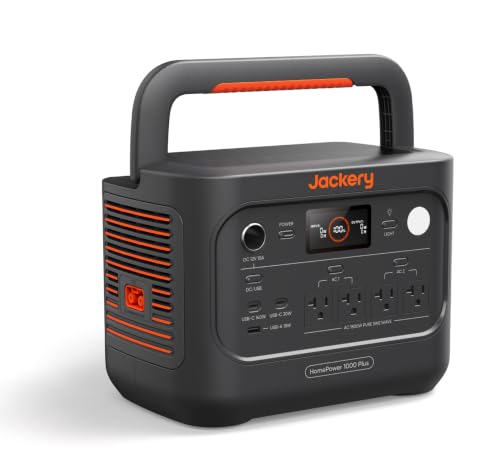
Verdict: A home-backup version of the 1kWh class, with smart outlet control and room to grow to 11kWh.
Key specs: 1,024Wh LiFePO4, 1,800W AC output, expandable to 11kWh with up to 5 battery packs (sold separately), four AC outlets on two separately controlled circuits, under 10ms UPS with surge protection, recharge in 1.25 hours, 140W USB-C.
The HomePower line is Jackery’s home-backup range. The feature that stands out is load management: the four AC outlets sit on two circuits you control separately. Put the fridge and router on the priority circuit, and the station cuts the less important circuit first as the battery runs low.
It’s the only 1kWh pick here that can expand past 5kWh, which suits households that plan to build a bigger backup system over time.

Pros:
- Two controllable circuits for priority loads
- Expandable to 11kWh
- Under 10ms UPS
- 140W USB-C for laptops
Cons:
- Very new, with only a handful of reviews so far
- Costs more than the Explorer 1000 v2 for similar capacity
Skip it if: you’d rather buy a model with a long review history. The Explorer 1000 v2 has thousands.
Owner rating: 5.0 out of 5 from 8 Amazon reviews (Amazon, retrieved 2026-10-25). That’s too few reviews to judge reliability yet.
Check the Jackery HomePower 1000 Plus v2 price on Amazon
Best 2kWh power stations for a fridge and furnace
A 2kWh station is where winter backup gets serious. It’s the size to look at if you want to keep a gas furnace’s blower running alongside the fridge. See how to run a furnace on a power station before you buy.
6. EcoFlow DELTA 3 Max: Best 2kWh Value
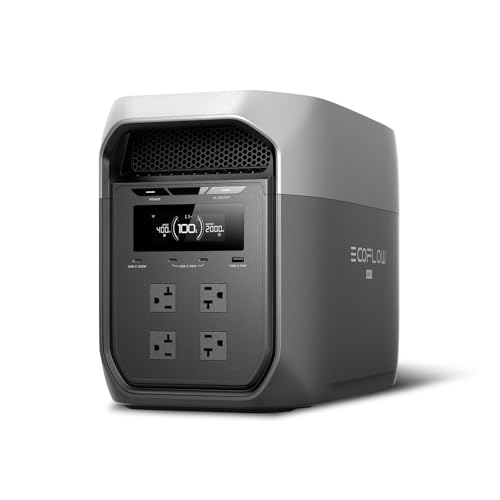
Verdict: Twice the battery of a 1kWh station for less than twice the price.
Key specs: 2,048Wh LFP battery, 2,400W AC output, up to 3,400W continuous in X-Boost mode, under 10ms transfer time, 0-80% charge in 1.13 hours.
The DELTA 3 Max is the 2kWh pick for most people. The capacity covers a fridge and a furnace blower for a meaningful stretch of a cold night, and the 2,400W output leaves room for a kettle or microwave in between.
The under-10ms transfer time is fast enough for most electronics if you leave it plugged in. EcoFlow also says it’s quiet, which matters when it’s running in the living room.

Pros:
- Strong price for 2kWh
- Fast 0-80% charging
- Under 10ms switchover
- Over 600 reviews at 4.7 stars
Cons:
- Heavier than the 1kWh units, so it’s less portable
- EcoFlow’s use limit is 14°F
Skip it if: you only need the fridge and router. A 1kWh station is lighter and cheaper.
Owner rating: 4.7 out of 5 from about 650 Amazon reviews (Amazon, retrieved 2026-10-25).
Check the EcoFlow DELTA 3 Max price on Amazon
7. Jackery HomePower 2000 Plus v2: Best Expandable Home Backup
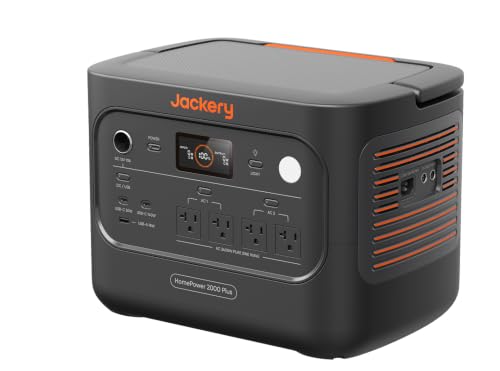
Verdict: A 2kWh station built to grow into a whole-home backup system.
Key specs: 2,048Wh LFP battery, 2,400W AC output, expandable to 12kWh, Smart Energy Management with Priority Routing, 6,000+ battery cycles, 140W USB-C.
If you live somewhere with long winter outages, the HomePower 2000 Plus v2 is the one to build around. It starts at 2kWh, then expands to 12kWh with extra batteries. That’s enough to cover several days of essentials.
Priority Routing keeps your most important loads running as the battery gets low. Jackery rates the battery for 6,000+ cycles, which is more than most stations here.

Pros:
- Expands to 12kWh
- Priority Routing for essential loads
- 6,000+ cycle battery
- Fast 140W USB-C
Cons:
- New model with only about 20 reviews so far
- The listing doesn’t state recharge time or UPS switchover
Skip it if: you don’t plan to expand. The DELTA 3 Max gives you 2kWh for less.
Owner rating: 4.6 out of 5 from about 20 Amazon reviews (Amazon, retrieved 2026-10-25).
Check the Jackery HomePower 2000 Plus v2 price on Amazon
8. BLUETTI Elite 200 V2: Best for Big Startup Loads

Verdict: The highest continuous output of the 2kWh picks, with low standby drain.
Key specs: 2,073.6Wh LiFePO4, 2,600W continuous AC output, 3,900W with power lifting, standby use of about 10W, automotive-grade LiFePO4 cells rated for a 17-year lifespan.
Motors like fridge compressors, well pumps and furnace blowers need a burst of extra power to start. The Elite 200 V2’s 2,600W continuous output gives it the most headroom in the 2kWh group for those startup loads.
The low 10W standby drain matters in a long outage. Over a day, a station idling at 30W wastes much more battery than one idling at 10W. BLUETTI also rates its stations for use down to -4°F.
Pros:
- 2,600W continuous output
- Low standby drain
- Rated for use down to -4°F
- Strong 4.7-star rating from 950 reviews
Cons:
- Not expandable like the Jackery HomePower
- The listing doesn’t state recharge time or UPS switchover
Skip it if: you want to add batteries later.
Owner rating: 4.7 out of 5 from about 950 Amazon reviews (Amazon, retrieved 2026-10-25).
Check the BLUETTI Elite 200 V2 price on Amazon
Best power station for multi-day outages
9. Jackery HomePower 3000: Best for Multi-Day Outages
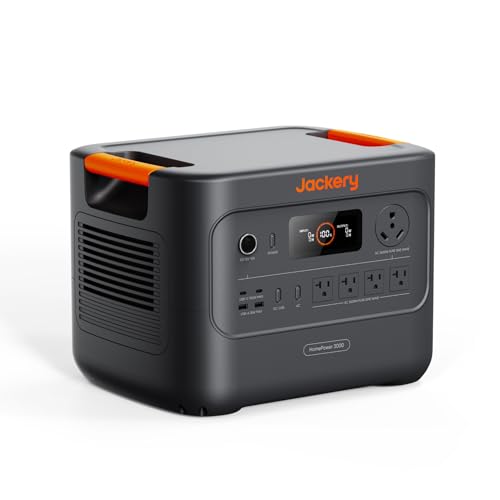
Verdict: The biggest battery here, for storms that knock power out for days.
Key specs: 3,072Wh capacity, 3,600W AC output (7,200W surge), UL-certified UPS that switches in 20ms or less, full recharge in 2.2 hours on AC or 1.7 hours with AC and DC together, dual 100W USB-C.
The HomePower 3000 holds about three times the energy of a 1kWh station. Its 7,200W surge rating is the highest here, which helps with motor startups like a well pump or furnace blower.
The hybrid charging option is useful in a long outage. If you have a generator or solar panels, you can refill it in under 2 hours whenever you have power, then run quietly on battery the rest of the time.

Pros:
- 3,072Wh capacity
- 7,200W surge for motor startups
- UL-certified UPS
- Fast hybrid recharge
Cons:
- The most expensive pick here
- Heavy, so pick a spot and leave it there
Skip it if: your outages rarely last more than a night.
Owner rating: 4.5 out of 5 from about 250 Amazon reviews (Amazon, retrieved 2026-10-25).
Check the Jackery HomePower 3000 price on Amazon
Best small power station for CPAP and essentials
10. EcoFlow RIVER 2 Pro: Best Small Unit for CPAP and Essentials

Verdict: A light, affordable station for phones, Wi-Fi, lamps and a CPAP.
Key specs: 768Wh LFP battery, 800W AC output (up to 1,600W with X-Boost for resistive loads), 11 outlets, full AC recharge in 70 minutes, 220W solar input (3.5 hours), 3,000+ cycles to 80%, 17.2 lb.
Not every home needs to run a fridge. If you mainly want to keep phones charged, the router online and a CPAP running through the night, the RIVER 2 Pro does it for much less than a 1kWh station. At 17.2 pounds it’s easy to carry to a bedroom.
The 70-minute recharge means you can refill it at a neighbor’s house, a warming center or from your car during a longer outage.

Pros:
- Light and easy to move room to room
- 70-minute recharge
- 11 outlets
- Over 1,800 reviews
Cons:
- 800W output won’t run a fridge plus other loads comfortably
- Not expandable
Skip it if: you want to keep food cold through the outage.
Owner rating: 4.5 out of 5 from about 1,820 Amazon reviews (Amazon, retrieved 2026-10-25).
Check the EcoFlow RIVER 2 Pro price on Amazon
How to choose a power station for winter outages
How much capacity you need
Use this quick formula: watt-hours x 0.85 ÷ watts = hours of runtime. The 0.85 allows for energy lost in the inverter.
Check the label on each device for its wattage, or use a plug-in watt meter. The examples below assume typical loads. Your own devices will differ.
| Device (example load) | 768Wh station | 1,024Wh station | 2,048Wh station |
|---|---|---|---|
| Wi-Fi router (15W) | About 43 hr | About 58 hr | About 116 hr |
| CPAP without humidifier (40W) | About 16 hr | About 22 hr | About 43 hr |
| Fridge, averaged over its on/off cycle (150W) | About 4 hr | About 6 hr | About 12 hr |
| Space heater on low (750W) | Under 1 hr | About 1 hr | About 2 hr |
The space heater row is the important one. Electric heat drains a battery very quickly, so a power station is better at keeping a gas furnace’s fan running than at heating a room on its own.
Running a gas furnace on a power station
Most gas and oil furnaces still need electricity for the blower fan, the igniter and the controls. Without power, there’s no heat, even with a full gas supply.
Check the furnace label for its wattage. Blower motors also need extra power for a moment when they start, so choose a station with plenty of output above the running wattage. The 2kWh picks and the HomePower 3000 are the best fit.
Most furnaces are hardwired, not plugged in. The safe way to connect a power station is a transfer switch or a power inlet installed by a licensed electrician. Never backfeed power through a wall outlet. A smart thermostat also helps the furnace run efficiently once power is back; see our guide to smart thermostats for cold climates.
Cold-weather limits: charge above 32°F
All four brands here tell you not to charge their stations below 32°F (0°C). Their use limits vary (Backup Power Hub, retrieved 2026-10-25):
| Brand | Charging | Using (discharging) |
|---|---|---|
| Jackery | 32 to 113°F | 14 to 113°F |
| EcoFlow | 32 to 113°F | 14 to 113°F |
| Anker SOLIX | 32 to 104°F | -4 to 104°F |
| BLUETTI | 32 to 104°F | -4 to 104°F |
In practice: keep your power station indoors, not in a cold garage, car or shed. If it has been outside, let it warm up to room temperature before charging. Check your own model’s manual, as limits can differ between models.
UPS switchover: 10ms vs 20ms
A UPS (uninterruptible power supply) feature lets you leave the station plugged in between your wall outlet and your devices. When power cuts out, it switches to battery automatically. At 10ms, most computers and routers won’t restart. At 20ms, lamps, fridges and chargers are fine, but some desktop computers may reboot. Medical devices should follow the manufacturer’s backup advice.
Recharging during a long outage
You have four main options:
- A running car through the 12V port (slow, and only with the car outside, never in a closed garage)
- Solar panels, which work in winter sun but not under snow, so brush them off
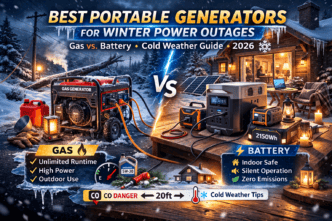
- A gas generator outdoors, then run the station quietly indoors overnight; see our winter generator guide
- Anywhere with power, like a friend’s house, an office or a warming center, which is where fast-charging models shine
Power station or gas generator?
A gas generator produces far more energy per dollar and can run for days on fuel. But it must run outdoors, away from doors and windows, because of carbon monoxide. A battery power station makes no fumes, is nearly silent and can run in your living room. Many households use both: the generator outside in the day, and the power station inside at night.
Expandability and battery life
Every pick here uses LiFePO4 (LFP) cells, rated for thousands of charge cycles. If you might need more backup later, the EcoFlow DELTA 3 (to 5kWh) and the Jackery HomePower models (to 11-12kWh) let you add batteries instead of buying a second station.
Finally, keep a good headlamp by the door. It saves battery for the things that matter.
Power station FAQ
How long will a power station run a refrigerator?
It depends on your fridge. Using the formula above, a fridge that averages 150W over its on/off cycle runs about 6 hours on a 1kWh station and about 12 hours on a 2kWh station. Keep the door closed to stretch that.
Can a portable power station run a furnace?
It can run the blower fan and controls of a gas or oil furnace, which is what keeps the heat on. Choose a 2kWh or larger station with enough surge for the blower motor, and have an electrician install a transfer switch or inlet.
Can I use a power station indoors?
Yes. Battery power stations produce no exhaust, so they’re safe indoors. Keep them away from water and follow the manual. Gas generators must always run outdoors.
Can I charge a power station in the cold?
Not below freezing. Jackery, EcoFlow, Anker and BLUETTI all set 32°F (0°C) as the minimum charging temperature. Warm the station to room temperature first.
What size power station do I need for a power outage?
About 700-1,100Wh for phones, Wi-Fi and a CPAP; 1,000-1,200Wh for a fridge for about a day; around 2,000Wh for a fridge plus a furnace blower; 3,000Wh or an expandable system for multi-day outages.
Can a power station run a space heater?
Only briefly. A 750W space heater empties a 1kWh station in about an hour. It’s much more efficient to power your furnace’s blower and let the gas do the heating. For garages, see our garage heater guide.
Power station or generator for winter storms?
For short outages and indoor use, a power station. For long outages where you need lots of energy, a generator outdoors, ideally paired with a power station for quiet overnight power.
Bottom line: which power station should you buy?
- Phones, Wi-Fi and CPAP: the EcoFlow RIVER 2 Pro.
- Fridge and essentials overnight: the Jackery Explorer 1000 v2, or the BLUETTI AC180 to save money.
- Home office with a fast UPS: the Anker SOLIX C1000 Gen 2.
- Furnace blower plus fridge: the EcoFlow DELTA 3 Max, or the Jackery HomePower 2000 Plus v2 if you’ll expand later.
- Multi-day storms: the Jackery HomePower 3000.
Whichever you choose, charge it fully before the first storm and store it indoors. A power station is only useful if it’s full when the lights go out.